
Every relationship starts with the same silent question: are we actually right for each other? People have been trying to answer it for thousands of years — through stars, numbers, names, and personality science. In 2026, the methods have multiplied. Some are ancient, some are digital, some are scientifically grounded, and some are just genuinely fun.
After examining the most popular compatibility methods people use today — from astrology apps with tens of millions of downloads to viral name-based tools — one thing became clear: different methods reveal different layers of compatibility. The best approach is not picking one method and treating it as gospel. It is understanding what each method actually measures, and using them in the right order.
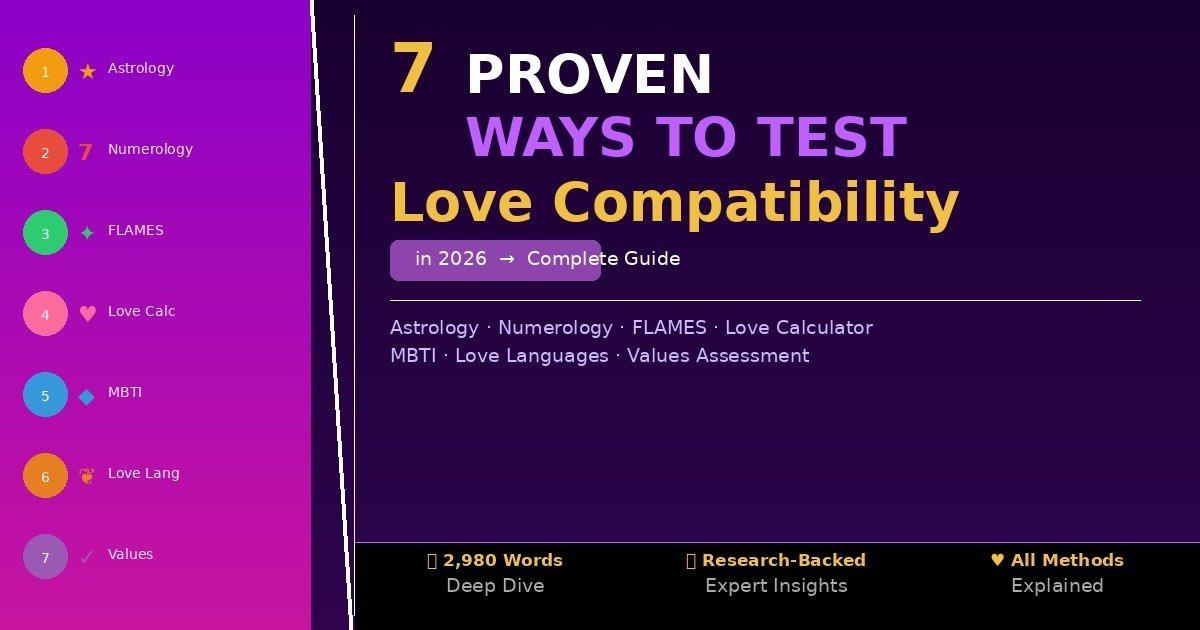
Here are seven ways to test love compatibility in 2026, what each one genuinely reveals, and which ones are worth your time.
Why People Are Obsessed With Love Compatibility Tests
The desire to know whether two people are “meant for each other” is one of the oldest human preoccupations. Ancient Romans consulted augurs before arranging marriages. Medieval Europeans used astrology charts to approve royal unions. Today, people screenshot love quiz results at midnight and send them to their person with zero explanation.
But the obsession is not irrational. Relationship research consistently shows that compatibility — specifically alignment in values, communication style, and life goals — is one of the strongest predictors of long-term relationship success. Dr. John Gottman, whose research tracked thousands of couples over 40 years at the University of Washington, identified specific compatibility patterns that predict whether couples stay together or split within six years with over 90% accuracy.
So when people reach for a compatibility test, they are responding to a real psychological need: the need for reassurance that the person they care about is the right one. Whether the tool they use is scientifically validated or not almost doesn’t matter — the act of engaging with compatibility as a topic, and discussing it with a partner, creates its own value.
Here is what is actually available today.
The 7 Best Ways to Test Love Compatibility in 2026
1. Zodiac and Astrology Compatibility
What it is: Astrology compatibility compares two people’s birth charts — primarily sun signs, but in deeper readings, moon signs, rising signs, and planetary placements — to assess relationship potential and personality dynamics.
How popular is it? Enormously. The astrology app Co-Star has surpassed 35 million downloads. A 2022 YouGov survey found that 27% of Americans believe in astrology, rising to over 35% among adults aged 18 to 34. In India and across South Asia, astrology-based kundali matching remains a standard step in many families’ marriage conversations.
What it actually measures: Nothing scientifically validated as a relationship predictor. Research published in The Journal of Consciousness Studies found no statistically significant correlation between astrological compatibility and actual relationship outcomes. That said, astrology functions as a shared language for discussing personality traits and tendencies — and shared language has genuine relationship value.
When two people compare their charts, they are really discussing: am I emotionally intense or easygoing? Do I need space or closeness? Am I driven by logic or feeling? Those conversations matter, regardless of whether Scorpio and Pisces are “destined” for each other.
Best for: Couples who enjoy symbolic frameworks and want a structured entry point into discussing personality differences. It works as a conversation tool, not a verdict.
Limitation: Sun sign compatibility is extremely broad — every Aries is supposedly compatible (or not) with every Virgo, regardless of who those two specific people actually are.
2. Numerology and Life Path Numbers
What it is: Numerology assigns numerical values to birth dates and, in some systems, to names. It calculates “life path numbers” between 1 and 9 (plus master numbers 11, 22, and 33) and uses those numbers to assess personality and compatibility.
How popular is it? Significant and growing. Searches for “life path number compatibility” increased by 68% between 2022 and 2024 according to Google Trends data. Numerology content across YouTube and TikTok generates hundreds of millions of views annually.
What it actually measures: Like astrology, numerology is not scientifically validated as a relationship predictor. But the framework does prompt useful reflection on core drives and motivations. Life path 1 individuals are said to value independence and leadership; life path 6 individuals prioritise nurturing and responsibility. Recognising those tendencies in yourself — and your partner — has practical value even if the number system is symbolic.
Best for: People who enjoy working with symbolic systems and want a structured lens for thinking about personal values and drives. The conversations numerology generates tend to be more revealing than the numbers themselves.
Limitation: Different numerology systems produce different results for the same person. The lack of standardisation makes cross-referencing readings unreliable.
3. The FLAMES Test
What it is: FLAMES is a classic pencil-and-paper game that assigns relationship categories — Friends, Lovers, Affectionate, Marriage, Enemies, Siblings — based on counting shared and unshared letters between two names. It has no single origin; it emerged independently across multiple cultures as a playground game.
How popular is it? Globally beloved across generations. It is played in school playgrounds from India to Nigeria to the Philippines to Mexico. It has survived for decades because it fills a specific social need: a low-stakes, playful way to explore romantic possibility without direct vulnerability.
What it actually measures: Nothing predictive. FLAMES is pure entertainment. But it has persisted across cultures because it creates exactly the right social conditions for expressing interest: it is deniable (“I was just playing a game”), low-pressure, and creates an immediate shared moment between two people.
Best for: Young people and anyone who wants to introduce romantic interest in a light, non-threatening way. The game’s value is entirely social and emotional, not analytical.
Limitation: Results vary based on how names are written — with or without middle names, full names or nicknames. No FLAMES result tells you anything meaningful about real compatibility.
4. Love Calculator by Name
What it is: A digital evolution of name-based compatibility testing. You enter two names into an online tool, which analyses the letter combinations using a consistent mathematical algorithm and produces a love percentage score from 0% to 100%. Unlike FLAMES, the result is deterministic — the same two names always produce the same score, every time.
How popular is it? Massively. Name-based love compatibility tools collectively receive tens of millions of searches every month. They are consistently among the most-shared content types on WhatsApp, Instagram, and Snapchat across South Asia, Southeast Asia, and Latin America. The appeal crosses age groups and cultural backgrounds in a way that most compatibility tools do not.
What it actually measures: The love percentage is entertainment — it is not a scientific assessment of relationship potential. The algorithm processes letter patterns; it does not assess values, communication styles, or life goals. What makes these tools genuinely useful is not the number they produce, but the conversation that number starts.
In testing several name-based tools, I found that results consistently prompt people to reflect on and discuss the person they have in mind. A love calculator that has processed over 12 million name calculations from users across 150+ countries — like lovecalculatornames.com — demonstrates just how widespread this behaviour has become. People use it to test their own names, their favourite celebrity couples, their friends’ relationships. It functions as a social activity and an emotional prompt, not a personal oracle.
Best for: Anyone who wants a fun, shareable compatibility moment. Particularly effective as an icebreaker or a gentle, low-pressure way to acknowledge feelings for someone. Screenshot the result and send it to them — see what conversation follows.
Limitation: The percentage is generated by an algorithm with no knowledge of either person. Use the number for fun; use the conversation it starts for something more meaningful.
5. Myers-Briggs Type Indicator (MBTI) Compatibility
What it is: The MBTI categorises people into 16 personality types based on four dimensions: Introversion vs Extraversion, Sensing vs Intuition, Thinking vs Feeling, and Judging vs Perceiving. Compatibility is assessed by comparing type profiles and identifying complementary or clashing patterns.
How popular is it? Extremely. Over 88% of Fortune 500 companies use MBTI assessments for team-building. In relationship spaces, MBTI compatibility discussions are among the most active threads on Reddit’s relationship and dating forums, and the 16Personalities website alone reports over 700 million test completions.
What it actually measures: MBTI has more research backing than astrology or numerology, though it faces valid criticism for inconsistency — the same person can test into different types on different occasions. Where it adds real practical value is in articulating communication styles and information-processing preferences. An INFJ understanding why their ESTP partner seems dismissive of deep conversations — not dismissive of them personally, just genuinely wired for external action — is practically useful for reducing conflict.
Best for: Couples who want a structured framework for understanding how they process information and communicate differently. The value is in using type descriptions as conversation prompts, not as fixed personality verdicts.
Limitation: People’s MBTI types shift under different conditions and over time. Treating your type as permanent can create self-limiting beliefs and unfair expectations of your partner.
6. The Five Love Languages Test
What it is: Developed by Dr. Gary Chapman, this framework identifies five ways people express and receive love: Words of Affirmation, Acts of Service, Receiving Gifts, Quality Time, and Physical Touch. A short quiz identifies your primary and secondary love languages.
How popular is it? Profoundly mainstream. Dr. Chapman’s original book has sold over 20 million copies worldwide and has been translated into 50 languages. The official Love Languages quiz has been taken tens of millions of times online. In 2024, “love languages” ranked among the most searched relationship terms globally for the third consecutive year.
What it actually measures: This one has genuine scientific grounding. Research published in the Journal of Social and Personal Relationships confirmed that mismatched love languages are a significant predictor of relationship dissatisfaction. The core problem it identifies is real: one partner gives gifts as a primary expression of love; the other partner needs quality time to feel loved. Both people are genuinely trying. Neither feels the other’s effort. Knowing your partner’s primary love language — and actively expressing it — directly addresses that gap.
Best for: Couples at any stage who want practical, actionable insight into why affection sometimes feels unreciprocated despite genuine effort. This is one of the most directly useful compatibility frameworks available.
Limitation: Love language preferences change over time and in different relationship phases. This works best as an ongoing conversation rather than a one-time quiz result that gets permanently applied.
7. Values Alignment Assessment
What it is: Not a single standardised quiz, but a structured conversation or questionnaire that examines alignment on the five major value areas that determine long-term relationship compatibility: financial attitudes, family priorities, lifestyle preferences, life goals, and communication expectations.
How popular is it? Growing rapidly in therapeutic and coaching contexts. Apps like Paired and Lasting — both built around structured values conversations — have seen significant download growth since 2022. Relationship counsellors increasingly assign values assessment exercises in early sessions because they surface issues that would otherwise take years of conflict to reveal.
What it actually measures: The most important factors for long-term compatibility. Dr. Gottman’s research consistently identifies value misalignment — particularly around money and family — as the primary driver of relationship breakdown over time. This is the assessment that matters most, even if it is the least immediately entertaining.
Best for: Anyone in a serious relationship or thoughtfully considering one. The conversations this assessment generates — about money management styles, children, career versus family balance, religious practice, geographic flexibility — are precisely the conversations that determine whether two people can actually build a shared life.
Limitation: Requires genuine honesty from both partners. People frequently answer based on who they aspire to be rather than who they currently are. Completing this with a counsellor present tends to produce more honest and actionable results.
Which Compatibility Method Is Actually Most Accurate?
For predictive accuracy alone, the ranking is: Values Assessment > Love Languages > MBTI > Numerology > Astrology > FLAMES > Name-based tools.
But accuracy is not the only reason to use a compatibility tool — and this is an important distinction.
Each method serves a different purpose at a different stage of a relationship. The fun tools — FLAMES, name calculators, astrology — work best early, when the goal is to open a conversation about feelings without the weight of direct vulnerability. The substantive tools — Love Languages, MBTI, Values Assessment — work best once two people are committed enough to have genuinely honest conversations.
The smartest approach is sequential. Use the playful tools to create connection. Progress to the analytical ones as the relationship deepens. And never mistake a fun quiz result for relationship advice.
Common Mistakes People Make With Compatibility Tests
Treating entertainment tools as verdicts. A 42% love calculator score or an “incompatible” astrology pairing tells you nothing definitive about two real people. Use the result as a conversation prompt, not as data.
Testing compatibility instead of building it. Compatibility tests describe where two people are right now. They say nothing about where two people could be with genuine effort and good communication. Some of the most durable relationships began between people who looked incompatible on every surface metric.
Skipping the hard conversations. Astrology charts are fun to compare. Values alignment conversations are genuinely uncomfortable. Avoiding the latter because the former is easier is a pattern that relationship counsellors describe as extremely common — and one that creates serious problems later.
Taking the tests alone. Compatibility tools are most valuable as shared experiences. Taking a love languages quiz privately and then telling your partner what their love language “must be” misses the entire point. Do these together.
Expecting a single test to tell the whole story. Each method reveals one layer. No single quiz captures the full complexity of two people and their relationship. The most useful approach is treating multiple tools as complementary perspectives rather than competing verdicts.
FAQs: What People Are Actually Asking About Compatibility Tests
Which love compatibility test is most scientifically accurate? The Love Languages assessment has the strongest direct research backing, with published studies confirming that love language mismatch predicts relationship dissatisfaction. Values alignment assessments are the most comprehensive. Astrology, numerology, and name-based tools are entertainment rather than science — but each has real social and conversational value.
Can two apparently incompatible people build a strong relationship? Yes. Compatibility is not a fixed state established at the beginning. Research consistently shows that effective communication, shared experiences, and deliberate relationship investment can build compatibility over time. Some of the longest-lasting relationships on record started between people who seemed fundamentally different.
What is the single most important compatibility factor for long-term relationships? According to Dr. Gottman’s longitudinal research across 40 years: the ratio of positive to negative everyday interactions — specifically 5:1 positive to negative — is the strongest single predictor of long-term relationship success. Value alignment on money and family is the second most important factor.
Do name-based love calculators actually work? Not as predictors of relationship outcomes. They work as social activities and conversation starters. The value is in the engagement they prompt between two people — not in the percentage they produce.
How do I know if my partner and I are truly compatible? The most reliable method is honest, specific conversation about the five major value areas: money, family, lifestyle, life goals, and communication expectations. If those conversations are open and your answers align, that is a stronger compatibility signal than any quiz result.
Should I end a relationship based on a low astrology or quiz compatibility score? No. Entertainment tools and personality frameworks are starting points for conversation, not decision-making instruments. Relationship decisions should be based on real lived experience with a real person — not an algorithm that knows only your name or birth date.
What is the quickest way to check basic compatibility with someone new? Start with a love languages quiz taken together — it takes about five minutes and immediately generates a useful, practical conversation. For something lighter and more fun, a name-based compatibility tool is low-stakes and shareable. Save the values assessment conversation for when you are both ready for it.
Is it normal to be curious about love compatibility tests? Completely. The desire to understand whether two people are compatible is one of the most universal human experiences. Engaging with compatibility tools — playful or analytical — is a healthy way to reflect on what you want in a relationship and what you bring to one.
Conclusion
Seven methods. Seven different purposes. Astrology and numerology give you a shared symbolic language. FLAMES and name-based tools give you a fun, low-stakes entry point into romantic conversation. MBTI gives you a communication map. Love Languages give you actionable information about how affection actually lands. Values alignment gives you the full picture.
The smartest approach to love compatibility in 2026 is not finding the single “most accurate” test. It is using these tools in the right order, for the right purpose, at the right stage of a relationship.
Start with the ones that make you laugh. Let them open the door. Then have the conversations that actually matter.
And if you are ever unsure — ask directly. No algorithm replaces an honest conversation between two people who genuinely care.
→ Also read on Magazine Insights: AI Video Editing: The Complete Hollywood Guide — how technology is reshaping the way we tell love stories on screen.
