
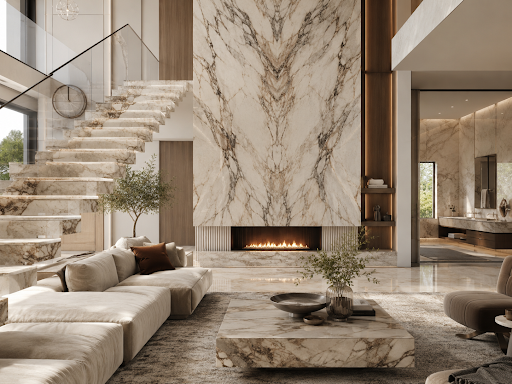
Luxury villa design has changed noticeably in recent years. Marble is no longer used only as a traditional flooring material or a decorative wall finish. In many high-end residential projects, marble has become part of the overall architectural language of the home. It is used to define entrance areas, living room feature walls, bathrooms, staircases, fireplace surrounds, kitchen islands, private lounges, spa rooms, and custom interior details.
For villa owners, developers, architects, interior designers, and overseas buyers, marble selection is both a design decision and a project planning decision. The right marble can make a villa feel elegant, timeless, and carefully built. The wrong selection, however, can create problems such as visual mismatch, difficult maintenance, unsuitable finishes, fabrication errors, or inconsistent slabs.
Luxury villa marble trends are not only about choosing rare or expensive stones. They are also about using marble more intelligently. Buyers are paying more attention to full slab selection, bookmatching, material consistency, wet-area suitability, cut-to-size fabrication, lighting effects, and the relationship between marble, wood, metal, glass, and soft interior materials.
For buyers planning marble for luxury villas, the key is to understand how marble works across different spaces, not just how it looks in a showroom. A luxury villa usually needs a coordinated stone strategy, from slab selection to fabrication, packing, and installation support.
Why Marble Remains Important in Luxury Villa Design
Marble remains popular in luxury villa interiors because it offers a combination of natural beauty, permanence, and architectural value. Every slab has its own veining, movement, and tone. This gives marble a level of uniqueness that many manufactured materials cannot fully reproduce.
In luxury villas, marble is commonly used for:
- Entrance foyer flooring
- Living room feature walls
- Bathroom wall cladding
- Vanity tops
- Kitchen islands
- Stair treads and risers
- Fireplace surrounds
- Private elevator areas
- Pool house bathrooms
- Spa and wellness rooms
- Decorative wall panels
- Custom furniture tops
A growing trend is to treat marble as a project material rather than a single surface choice. Instead of using random marble in different rooms, designers often build a complete material palette. They may choose one dramatic marble for a feature wall, one calmer marble for bathrooms, and a warm-toned stone for floors or transitional areas.
When comparing stone options, buyers often review a marble slabs supplier to understand available marble colors, slab sizes, veining styles, and possible applications before making final design and procurement decisions.
Trend 1: Large Marble Feature Walls
One of the strongest trends in luxury villa interiors is the use of large marble feature walls. These walls are often placed in living rooms, entrance halls, dining areas, stair halls, master bedrooms, or private lounges. A marble feature wall can act as the central visual point of the space.
Why Feature Walls Are Popular
Large marble walls create immediate impact. They can make a villa feel more architectural and customized. Unlike paint, wallpaper, or standard wall panels, a marble wall has natural depth and movement. It also reflects lighting in a way that makes the room feel more refined.
Common feature wall locations include:
- Behind a sofa in the living room
- Behind a TV or media wall
- Around a fireplace
- Behind a freestanding bathtub
- Behind a reception-style console in the foyer
- Along a staircase wall
- Behind a dining room display wall
What Buyers Should Check
For large feature walls, slab selection is critical. Buyers should not rely only on small samples. They should request full slab photos and review the complete pattern before cutting.
Important checks include:
- Slab size
- Vein direction
- Color balance
- Bookmatch possibility
- Thickness
- Surface finish
- Lighting effect
- Wall panel layout
- Edge and joint position
- Packing and installation sequence
A large marble wall should be planned as a visual composition. If the slab movement is too strong for the wall size, the final result may feel heavy. If the pattern is too weak, the wall may lose impact.
Trend 2: Bookmatched Marble Panels
Bookmatched marble remains highly desirable in luxury villas because it creates symmetry, drama, and a custom-made appearance. This effect is often used for feature walls, bathrooms, fireplace surrounds, headboard walls, and elevator backgrounds.
Where Bookmatching Works Best
Bookmatching is most effective in areas where people can view the stone from a distance. It needs enough wall space to show the mirrored pattern clearly. A double-height living room, large bathroom wall, entrance foyer, or luxury staircase wall can be suitable.
Common bookmatched applications include:
- Living room feature walls
- Master bathroom walls
- Fireplace backgrounds
- Dining room walls
- Private elevator surrounds
- Villa lobby-style entrance walls
- Spa rooms
- Luxury bedroom headboard walls
Practical Considerations
Bookmatched marble requires careful slab selection and dry layout planning. The supplier should provide photos showing how the slabs will match before cutting. Buyers should also confirm whether the panel size works with the wall dimensions.
Key questions include:
- Are matching slabs available?
- Is the slab sequence clear?
- Does the vein direction suit the wall?
- Are joints placed in acceptable positions?
- Will lighting highlight or distort the pattern?
- Are the panels labeled for installation order?
Bookmatching is not suitable for every area. In small bathrooms or narrow walls, a simpler marble pattern may look more balanced.
Trend 3: Spa-Style Marble Bathrooms
Luxury villa bathrooms are increasingly designed like private spa spaces. Marble is used to create calm, clean, and premium environments. Instead of small decorative tiles, many projects now use larger wall panels, integrated vanity tops, bathtub surrounds, and shower wall slabs.
Popular Bathroom Marble Applications
Marble in villa bathrooms may appear in:
- Full-height wall cladding
- Shower wall panels
- Vanity tops
- Bathtub surrounds
- Niche shelves
- Floor panels
- Thresholds
- Feature walls behind the bathtub
- Double vanity counters
- Matching backsplashes
Design Direction
Many spa-style bathrooms use soft white, beige, cream, grey, or warm-toned marble. The goal is often to create a calm and comfortable atmosphere rather than a highly dramatic one. Strong veining can still work, especially behind a bathtub or vanity, but it should be used carefully.
Technical Checks
Bathrooms require more practical review than dry living spaces. Buyers should confirm:
- Wet or dry application
- Surface finish
- Cleaning expectations
- Joint placement
- Shower wall size
- Vanity top cutouts
- Faucet hole positions
- Bathtub surround details
- Drainage and slope requirements
- Packing labels for each bathroom
A bathroom may look simple in a rendering, but it often requires many custom stone pieces. Missing or incorrect small pieces can delay installation.
Trend 4: Marble Staircases as Architectural Features
Marble staircases are another strong trend in luxury villas. A staircase can become one of the most memorable architectural elements of a home. Marble treads, risers, landings, and side panels can create a grand and permanent impression.
Why Marble Stairs Are Popular
Marble stairs are durable when properly selected and installed, and they create a strong sense of luxury. They also connect multiple floors visually. In large villas, the staircase may be placed near the entrance or central hall, making it a major design feature.
Important Stair Details
Stone staircases require accurate measurements. Buyers and contractors should confirm:
- Tread dimensions
- Riser dimensions
- Landing size
- Edge profile
- Surface finish
- Anti-slip details where needed
- Lighting integration
- Handrail connection
- Skirting or side panels
- Installation sequence
A staircase is not forgiving. If one piece is wrong, it may affect the entire installation. Clear drawings and piece labels are essential.
Trend 5: Marble and Wood Combinations
Luxury villa interiors are moving toward warmer material combinations. Marble is often paired with wood to create balance. Marble brings elegance and structure, while wood adds warmth and comfort. This combination is especially common in living rooms, bedrooms, bathrooms, kitchens, and private lounges.
Common Pairing Ideas
Marble and wood can be combined in several ways:
- Marble feature wall with wood shelving
- Marble floor with wood ceiling details
- Marble vanity top with wood cabinetry
- Marble fireplace with wood wall panels
- Marble kitchen island with wood cabinets
- Marble stair treads with wood handrails
- Marble bathroom walls with warm wood storage
Why This Trend Works
Too much marble can sometimes make a space feel cold. Wood softens the atmosphere and makes the villa feel more livable. The best designs usually control the balance between the two materials.
Designers should compare marble and wood samples under project lighting. Warm beige marble may pair well with walnut or oak. Cool grey or white marble may work better with lighter wood, black metal, or brushed stainless steel.
Trend 6: Custom Marble Details
More luxury villa projects are using marble in custom details instead of only large surfaces. These details help make the home feel more personalized.
Examples of Custom Marble Details
Custom marble details may include:
- Fireplace surrounds
- Floating vanity tops
- Integrated sink designs
- Marble benches
- Window sills
- Decorative wall trims
- Shower niches
- Marble shelves
- Bar counters
- Wine room counters
- Marble side tables
- Door surrounds
- Private elevator frames
These details require precise fabrication. Small errors can be more obvious because custom pieces are often placed at eye level or used daily.
Fabrication Considerations
Before producing custom marble details, buyers should confirm:
- Final dimensions
- Thickness
- Edge profile
- Visible edge location
- Cutouts
- Surface finish
- Joint position
- Installation method
- Packing protection
- Room labels
Custom details are one of the areas where supplier experience matters most.
Trend 7: Warm Neutral Marble Palettes
Although bold marble is still popular, many villa projects now favor warm neutral stone palettes. Beige, cream, taupe, soft grey, and warm white marble are often used to create calm and timeless interiors. These colors work well with wood, bronze metal, soft lighting, and natural fabrics.
Why Warm Neutrals Are Popular
Warm neutral marble feels luxurious without being too aggressive. It is suitable for long-term residential use because it does not depend too heavily on short-term trends. It can also make large spaces feel more comfortable.
Common warm neutral applications include:
- Entrance floors
- Bathroom walls
- Spa rooms
- Living room floors
- Staircases
- Kitchen islands
- Fireplace surrounds
- Bedroom feature walls
What Buyers Should Watch
Neutral marble can still vary by slab. Buyers should check whether the stone has yellow, pink, grey, or brown undertones. These undertones should match the wood, paint, lighting, and furniture palette.
Trend 8: Marble in Indoor-Outdoor Living Spaces
Luxury villas often include outdoor terraces, pool houses, garden lounges, and semi-outdoor living areas. Stone materials are used to create a smooth transition between interior and exterior spaces. Marble may be used in protected indoor areas, while other natural stones such as granite, limestone, or travertine may be considered for outdoor zones depending on the project.
Indoor-Outdoor Stone Planning
Important planning questions include:
- Will the stone be exposed to rain or direct sun?
- Is the area wet or dry?
- Will people walk barefoot from the pool?
- Does the surface need a textured finish?
- Should indoor and outdoor stone visually match?
- How will the material be cleaned?
A single stone finish may not work for every area. Designers may use similar tones but different finishes to connect spaces while still meeting practical needs.
How Buyers Should Plan Marble Procurement
Luxury villa marble procurement should be organized early in the project. Waiting until the last stage can create problems with material availability, fabrication time, and installation schedule.
Step 1: Define the Application Areas
Buyers should list every area where marble will be used:
- Floors
- Walls
- Bathrooms
- Stairs
- Countertops
- Fireplace surrounds
- Outdoor transitions
- Custom details
Step 2: Confirm the Design Direction
The design direction should guide marble selection. A modern villa may need clean, calm slabs. A classic villa may use warmer or more decorative marble. A resort-style villa may require softer natural tones.
Step 3: Review Full Slabs
Full slab approval is important for visible areas. Buyers should ask for full slab photos, close-up images, slab numbers, and layout photos when needed.
Step 4: Confirm Fabrication Details
Before production, drawings and dimensions should be final. Cutouts, edge profiles, thickness, finish, and labels should be confirmed.
Step 5: Inspect and Pack Carefully
Before shipping, buyers should review inspection photos. Finished pieces should be packed strongly and labeled by room or installation area.
Common Mistakes in Villa Marble Selection
Mistake 1: Choosing Marble Only by Trend
Trends can inspire design, but the stone must still match the villa’s style, lighting, function, and maintenance expectations.
Mistake 2: Using Dramatic Marble Everywhere
A dramatic marble feature wall can be beautiful, but using strong patterns in every room may make the villa feel visually busy.
Mistake 3: Ignoring Bathroom Conditions
Bathroom marble should be reviewed for wet-area use, finish, cleaning, joint placement, and installation method.
Mistake 4: Not Approving Full Slabs
Small samples cannot show the full pattern. For feature walls, kitchen islands, and large bathrooms, real slab approval is important.
Mistake 5: Leaving Fabrication Details Too Late
Custom marble pieces need accurate drawings. If dimensions change after production, the finished pieces may not fit.
FAQ
1. What marble is best for luxury villas?
The best marble for luxury villas depends on the application and design style. White, beige, grey, and warm neutral marbles are common for floors, bathrooms, walls, and stairs. Dramatic marble can work well for feature walls and fireplaces. Buyers should choose marble based on room function, maintenance expectations, finish, and full slab appearance.
2. Is marble good for villa bathrooms?
Yes, marble is widely used in villa bathrooms for wall cladding, vanity tops, bathtub surrounds, shower walls, and feature walls. However, bathroom applications require careful review of surface finish, wet-area use, cleaning routine, joint placement, and installation method.
3. Are marble feature walls still popular?
Yes, marble feature walls remain popular in luxury villas. They are often used in living rooms, entrance halls, bathrooms, stair halls, dining rooms, and fireplace areas. Bookmatched marble and large-format slabs are especially common in high-end interiors.
4. How do you choose marble slabs for a villa project?
Buyers should review the application area, design style, color tone, veining, slab size, finish, thickness, and maintenance needs. Full slab photos should be approved before fabrication, especially for feature walls, bathrooms, countertops, and staircases.
5. What are the latest marble trends for luxury homes?
Current marble trends for luxury homes include large feature walls, bookmatched panels, spa-style bathrooms, marble staircases, warm neutral palettes, marble and wood combinations, custom stone details, and coordinated indoor-outdoor stone design.
Conclusion
Luxury villa marble trends are moving toward more thoughtful, project-based design. Marble is no longer used only as a decorative surface. It is being planned as part of a complete interior and architectural system that includes feature walls, bathrooms, staircases, fireplaces, kitchens, outdoor transitions, and custom details.
The best results come from balancing visual impact with practical planning. Buyers should review full slabs, confirm application suitability, choose the right finish, prepare accurate drawings, and coordinate fabrication before shipment. Dramatic marble can create memorable spaces, while warm neutral stone can support calm and timeless interiors.
For luxury villas, marble remains one of the strongest materials for creating long-term elegance. When selected and managed carefully, it can support both the design identity and the lasting value of a high-end residential project.
