
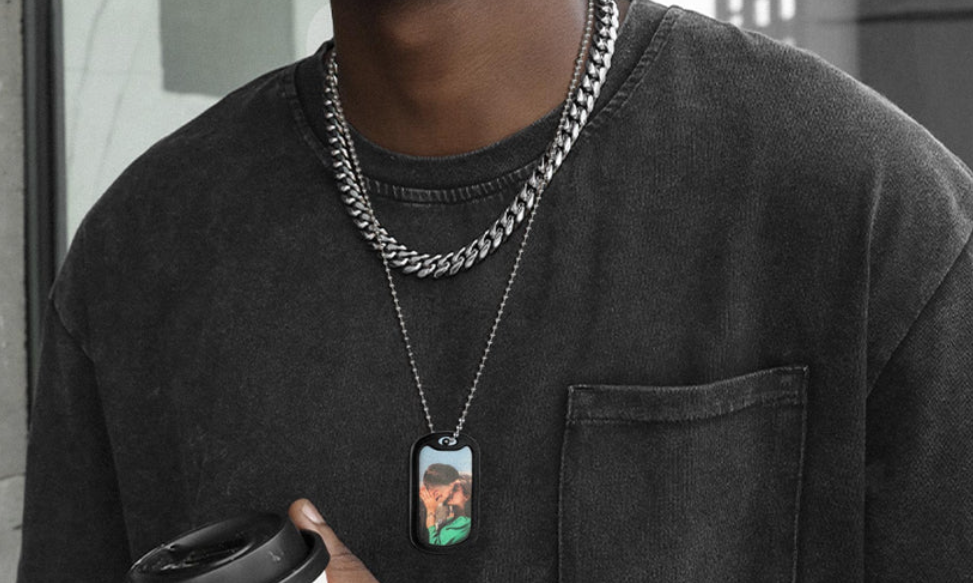
The dog tag has one of the more unusual histories in jewelry — it started as identification hardware, not a fashion piece, and that military origin still shows up in how the style is designed today, even on versions that have nothing to do with the armed forces. Understanding that background actually helps when choosing one, since it explains why certain proportions and finishes are considered “correct” for the style while others read as an imitation.
Why the Shape Never Changed
Original military tags were stamped with a specific rounded-rectangle shape and a notch at one end, originally intended to hold the tag in place during the stamping process. That shape has stuck for over a century, and most dog tag necklace designs today still reference it closely, even when the piece is purely decorative.
Fashion variations do exist — rounded corners, smaller proportions, mixed metal finishes — but the closer a design stays to the original stamped shape, the more it reads as intentional homage rather than a vague military-adjacent accessory.
Chain Style Matters More Than People Expect
A dog tag chain is traditionally a ball chain, not a standard link chain, and that’s not just an aesthetic choice. Ball chains were originally functional — the beaded design let the tag be removed quickly by feeding it through a gap in the chain, without needing a clasp that could fail or snag in the field.
Modern versions keep the ball chain largely for style continuity, though some now use a standard box or curb chain for a dressier look. If you’re going for an authentic military aesthetic, stick with ball chain. If you want the tag shape without the military association, a finer link chain shifts the whole look toward standard pendant jewelry.
What Gets Engraved, and Why It Matters
Traditional tags carried standardized information: name, service number, blood type, and religious preference, stamped rather than engraved, using a specific embossing process that left raised, easily-felt characters.
Civilian versions have adapted that format loosely. Common modern engravings include:
- A name or nickname, sometimes paired with a birth date
- Coordinates marking a meaningful location
- A short phrase or single word rather than a full sentence
- A child’s name for parents wearing the tag as a keepsake piece
One detail worth knowing before ordering a custom piece: stamped engraving (raised, punched letters) reads as more authentic to the original military style, while laser engraving produces a flatter, more legible result that’s easier to read at a glance but loses some of that stamped-metal character. Neither is wrong, but it’s worth deciding which effect you actually want before placing a custom order, since the two processes look distinctly different once finished.
Sizing and Wearing Multiple Tags
Dog tags are traditionally worn in pairs — one tag stayed with the body if needed, the other was collected separately — and that two-tag tradition carries over into modern jewelry more than most people realize. Wearing two tags on one chain, or two tags split across a short and long chain, is a common styling choice that nods to that history without needing any explanation to read as intentional.
Single-tag necklaces are more common for personalized or gift pieces, particularly when a photo or specific engraving is the focal point rather than the format itself.
Metal and Finish Options
Stainless steel is the standard for durability and cost, and it holds up to daily wear without the tarnishing concerns of silver. Black IP (ion-plated) finishes have become popular for a more modern, less literal military look, while classic silver-tone steel stays closest to the traditional aesthetic. Gold-toned versions exist but are less common, mainly because gold reads as more decorative than functional, which works against the utilitarian style the design is built around.
A Piece That Carries Weight Either Way
Whether it’s worn as a nod to military service, a personalized keepsake, or simply a style choice, the dog tag format carries more built-in history than most jewelry categories. That history is part of why the design has stayed remarkably consistent for over a hundred years — it’s one of the few pieces where the original functional design and the current fashion version haven’t drifted far apart at all.
