
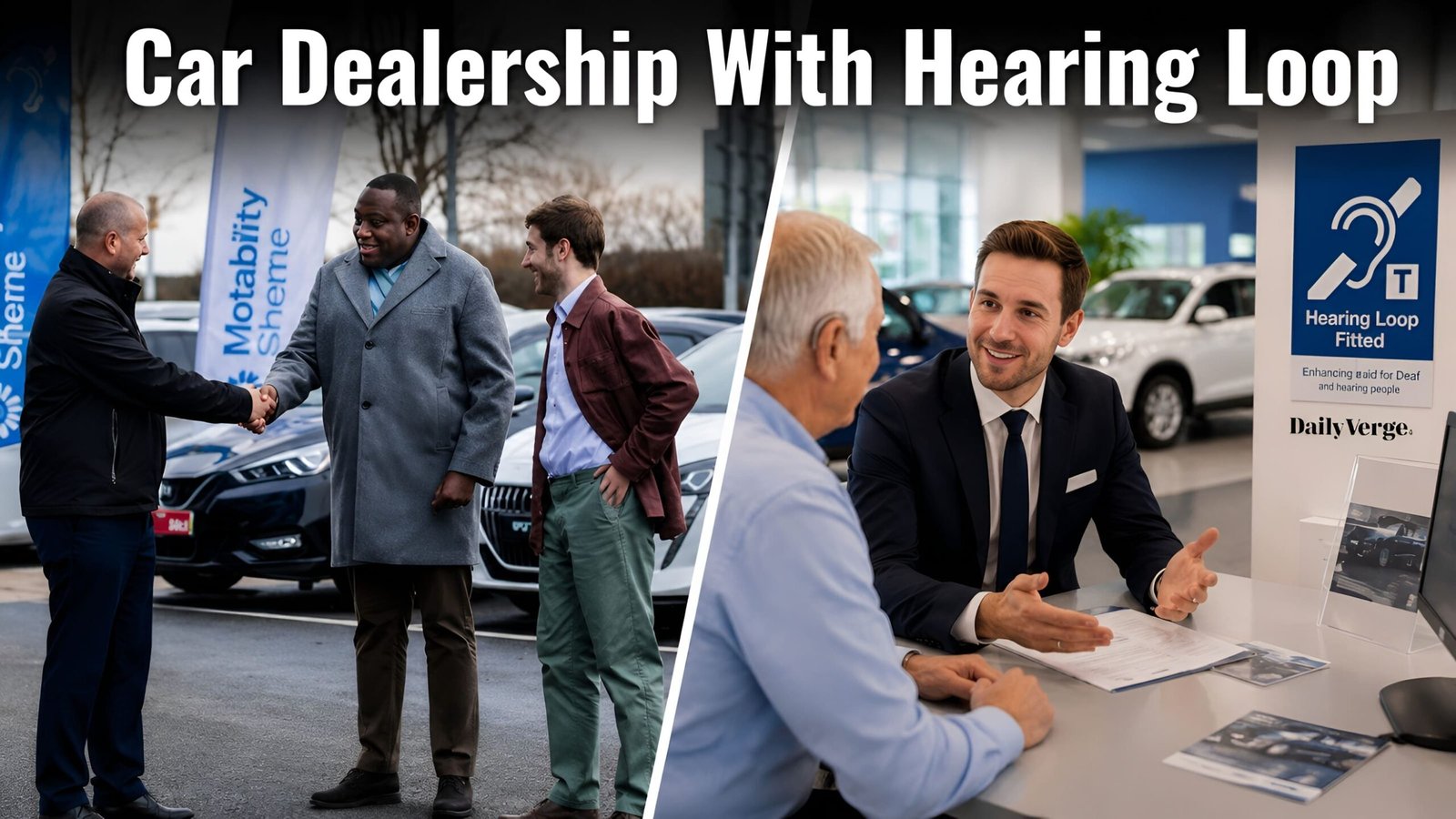
A car dealership with hearing loop is a showroom that has installed an induction loop system to help customers with hearing aids or cochlear implants communicate clearly. These systems use electromagnetic signals to transmit speech directly into hearing devices via the T-coil setting, cutting out background noise during important conversations about vehicles, finance, and paperwork.
What Is a Car Dealership With Hearing Loop?
A car dealership with hearing loop is an automotive showroom or service centre that has installed an assistive listening system designed to help customers with hearing loss communicate without barriers. The loop system works by converting a speaker’s voice into an electromagnetic signal, which is picked up directly by hearing aids or cochlear implants switched to the T-coil (telecoil) setting. Rather than amplifying all the noise in the room, it delivers a clear, targeted audio signal straight to the customer’s device.
This technology removes one of the most overlooked obstacles in retail — the inability of a hard-of-hearing customer to follow fast-paced, jargon-heavy conversations in noisy environments. In a car showroom, where background noise from engines, multiple conversations, and echoing floors is constant, the difference between having and not having a hearing loop can determine whether a customer understands their finance agreement or misses a key detail about their new vehicle.
Why Accessible Car Showrooms Are No Longer Optional in the UK
More than 12 million people in the United Kingdom currently live with some degree of hearing loss. That is roughly one in five of the entire population, a demographic so large that any dealership ignoring their needs is effectively closing its doors to millions of potential buyers. Car purchases are high-value, long-term decisions that require trust, clarity, and confidence — qualities that are impossible to achieve when a customer cannot hear properly.
The shift toward accessible showrooms is driven by both law and commercial logic. Customers who feel welcomed and understood are significantly more likely to complete a purchase, return for servicing, and recommend the dealership to others. Inclusive environments do not just serve people with hearing loss; they signal a business culture that values every customer equally, which has a measurable effect on brand reputation and word-of-mouth referrals.
How the Induction Loop System Actually Works Inside a Showroom
An induction loop system works by running a thin wire loop around the perimeter of a defined area — a reception desk, a finance room, or an entire waiting lounge. A microphone picks up the salesperson’s voice, an amplifier processes the signal, and the loop wire converts it into a low-intensity magnetic field. Any hearing aid or cochlear implant equipped with a telecoil function can detect this field and convert it back into clear, amplified sound.
There are two main types used in dealerships. Counter loops are compact and fitted beneath service desks or sales points, designed for one-to-one conversations. Room loops cover larger spaces like customer lounges or vehicle handover bays. Dealerships that invest in both types offer full coverage across the entire customer journey, from first enquiry to vehicle collection, ensuring nothing is lost in translation at any stage.
Legal Requirements — What the Equality Act 2010 Says to Dealerships
Under the Equality Act 2010, every service provider in the United Kingdom — including car dealerships — is legally required to make reasonable adjustments for disabled customers. Hearing loss is classified as a disability under this legislation, meaning dealerships have a legal duty to ensure that customers who use hearing aids are not placed at a substantial disadvantage. Installing a working induction loop at every customer-facing counter is one of the most direct ways to meet this obligation.
The UK building standard BS 8300, updated in 2018, goes further by specifying that any reception point or service counter in a noisy environment must have at least one hearing enhancement position. Part M of the Building Regulations also explicitly mentions service counters as locations requiring assistive listening systems. A dealership that has a reception desk and no functioning loop is not just failing its customers — it is potentially in breach of these regulations.
What Happens When You Visit a Hearing Loop Car Dealership
When you arrive at an accessible dealership, the process should feel seamless. Look for the international hearing loop symbol — a stylised ear with a diagonal line and the letter T — displayed at reception desks, finance offices, and service counters. This symbol indicates the loop is active. Simply switch your hearing device to the T or T+M setting to connect automatically, without needing to ask for special equipment or adjusting any settings at the dealership.
Good staff training is just as important as the technology itself. The best accessible dealerships train their team to face customers directly when speaking, confirm the loop is switched on before conversations begin, and avoid the habit of turning away to check a screen mid-sentence. A functional loop combined with considerate communication creates an experience that feels genuinely inclusive rather than tokenistic.
Major UK Dealership Groups Leading on Accessibility
Several large UK automotive groups have made meaningful progress on hearing loop provision. Arnold Clark, one of the UK’s largest car retailers, has equipped the majority of its sites with induction loops at sales and service points. Sytner Group and Vertu Motors have similarly integrated accessibility standards across their franchise networks as part of manufacturer accreditation requirements. Marshall Motor Group has also been noted for high levels of compliance across its sites.
Smaller independent used car dealerships are beginning to adopt these systems too, recognising that the cost of installation is relatively low compared to the commercial benefit of reaching a wider customer base. The growing awareness of disability rights among consumers means that a dealership without accessible communication tools is at a visible competitive disadvantage, particularly as review platforms increasingly flag accessibility as a factor in ratings and recommendations.
How to Find an Accessible Car Dealership With an Induction Loop Near You
Before visiting any showroom, a simple phone call or website check can save significant time and frustration. Ask the dealership directly whether they have a functioning induction loop at their reception and finance desks, and whether it has been tested recently. Many dealers list accessibility features on their websites under customer service or accessibility sections, and some manufacturer-affiliated sites include this information in their branch profiles.
Online review platforms such as Google Maps and Trustpilot sometimes include accessibility details in business listings, though coverage is inconsistent. The RNID (Royal National Institute for Deaf People) provides guidance on what to expect from businesses and can offer support if you feel a dealership has failed to make reasonable adjustments. Charity organisations focused on deaf and hard-of-hearing communities also maintain regional directories of accessible businesses worth consulting before making a long journey.
Questions to Ask Before You Visit — A Checklist for Hearing Aid Users
Going in prepared makes the whole experience more productive. Before visiting any showroom, consider asking whether the induction loop at the sales desk is currently active and regularly tested, whether staff are trained to assist customers who use hearing aids, and whether the finance room has a separate loop for private consultations. These questions are not demanding — they reflect the kind of due diligence any customer would apply.
Also ask whether written summaries of key financial and contractual details can be provided alongside verbal explanations. A dealership that offers both signals genuine commitment to accessibility rather than minimal compliance. If a dealership seems uncertain or dismissive about these questions during a phone call, that is itself useful information about the quality of service you are likely to receive in person.
The Business Case for Dealerships — Why Installing a Loop Increases Sales
Dealerships that invest in accessibility technology consistently report broader customer satisfaction improvements, not just among deaf or hard-of-hearing visitors. When communication is clearer for everyone, transactions move more efficiently, fewer details need to be repeated, and customers leave with greater confidence in what they have agreed to. This reduces post-sale disputes and improves review scores across all categories.
The financial logic is straightforward. A hearing loop counter system costs a few hundred pounds to install professionally, a fraction of a single vehicle sale margin. Against that one-off cost, the dealership gains access to a customer segment representing millions of people in the UK who actively seek and prefer businesses that demonstrate practical accessibility. Over a year, the return on that investment in terms of additional sales, referrals, and retained loyalty significantly outweighs the initial spend.
Staff Training — The Human Element That Technology Cannot Replace
Technology alone does not create an accessible environment. A hearing loop that is switched off, untested, or unknown to staff is effectively useless. Dealerships that take accessibility seriously invest in regular training so that every team member — from reception staff to finance managers — knows how to activate the loop, check signal strength, and guide customers through using the T setting on their device without making the interaction feel awkward or clinical.
Beyond the loop itself, trained staff understand communication basics: speaking clearly at a moderate pace, avoiding covering the mouth, confirming understanding at each stage of a complex conversation, and offering written support where verbal communication alone is not enough. These habits benefit all customers, not just those with hearing loss, and contribute to the kind of attentive, professional service that generates five-star reviews and repeat business.
What to Do If a Dealership Fails to Provide Accessible Communication
If you visit a dealership and find that no hearing loop is available, is broken, or that staff are unable or unwilling to assist you, you have several options. Raise the concern with the showroom manager directly, as this often resolves the issue quickly and gives the business the opportunity to correct an oversight. If the problem persists or you feel your experience constituted discrimination under the Equality Act, you can contact the Equality Advisory and Support Service (EASS) for guidance.
The RNID also provides support and can advise on formal complaints processes. In more serious cases where a dealership consistently fails to maintain accessible systems despite requests, legal remedies under the Equality Act 2010 are available. Most dealers, however, respond positively when issues are raised clearly and professionally, as compliance failures carry reputational and legal risks they are motivated to avoid.
Related Accessibility Features to Look for Beyond the Hearing Loop
A genuinely inclusive car dealership with hearing loop will typically offer additional features that support customers with various disabilities and communication needs. These might include written communication options at every stage of the buying process, quiet consultation rooms away from the showroom floor, visual display screens showing key financial figures, large-print brochures and documents, and accessibility-focused vehicle financing information in plain English.
Some forward-thinking dealerships also offer British Sign Language (BSL) interpretation appointments either in person or via video link, providing a further layer of communication support for customers who are profoundly deaf. Accessible car parks, wide doorways, and step-free access points complete the picture of a showroom designed to welcome every customer with equal dignity and practical support throughout their visit.
How to Use the T-Coil Setting on Your Hearing Device in a Dealership
Activating the T-coil setting on a hearing aid or cochlear implant is typically straightforward. Most devices have a dedicated T or T+M programme accessible via a button or through a companion smartphone app. When you enter a loop area and switch to this setting, your device will automatically pick up the magnetic signal broadcast by the loop, filtering out ambient noise in favour of the speaker’s voice coming through the microphone.
If you are unsure whether your specific device is telecoil-compatible, check with your audiologist before visiting a dealership. Older hearing aids are more likely to include this feature than some newer in-canal designs, where the telecoil may have been removed to allow for a smaller form factor. Your audiologist can confirm compatibility and help you set up a dedicated programme for loop environments, making future visits to any loop-equipped venue much simpler.
Conclusion
Choosing a car dealership with hearing loop is not just about convenience — it is about your right to clear, equal communication during one of the most significant purchases you will make. The UK legal framework is clear, the technology is proven and affordable, and the best dealerships understand that accessibility is not a concession but a core part of good service. Before your next dealership visit, confirm loop availability in advance, arrive prepared with your T-coil setting ready, and feel confident asking for the accessible communication you are entitled to. Dealerships that invest in inclusive environments earn the loyalty of customers who know they are valued — and that is good for everyone.
Frequently Asked Questions
Is every UK car dealership legally required to have a hearing loop?
Under the Equality Act 2010, any dealership with a reception desk or customer service counter is required to provide a hearing loop as a reasonable adjustment for customers with hearing loss. Not all comply, but it is a legal obligation rather than optional.
How do I activate the hearing loop when I arrive at a dealership?
Switch your hearing aid or cochlear implant to the T (telecoil) setting. You may see a T, T+M, or loop programme on your device or companion app. The international hearing loop symbol at the desk indicates the system is active.
What if the dealership’s loop is not working?
Ask staff to check it. If it remains unusable and the dealership cannot assist you effectively, you can raise a formal complaint through the Equality Advisory and Support Service (EASS) or seek guidance from the RNID.
Which major UK car dealers have good hearing loop coverage?
Arnold Clark, Sytner Group, Vertu Motors, and Marshall Motor Group are among the larger groups that have invested significantly in induction loop provision across their UK sites.
Can I bring a support person to help communicate at a dealership?
Absolutely. You are entitled to bring a family member, carer, or British Sign Language interpreter. Good dealerships will accommodate and welcome this without question.
Does a hearing loop work with cochlear implants as well as hearing aids?
Yes. Most cochlear implant processors include a telecoil function that works in exactly the same way as a hearing aid in a loop environment. Check with your audiologist to confirm your specific processor is compatible.
Are there any apps or tools that help me find accessible dealerships near me?
The RNID website provides resources, and some dealership group websites list accessibility features by branch. Calling ahead remains the most reliable method to confirm a loop is installed and currently functional at a specific location.
