
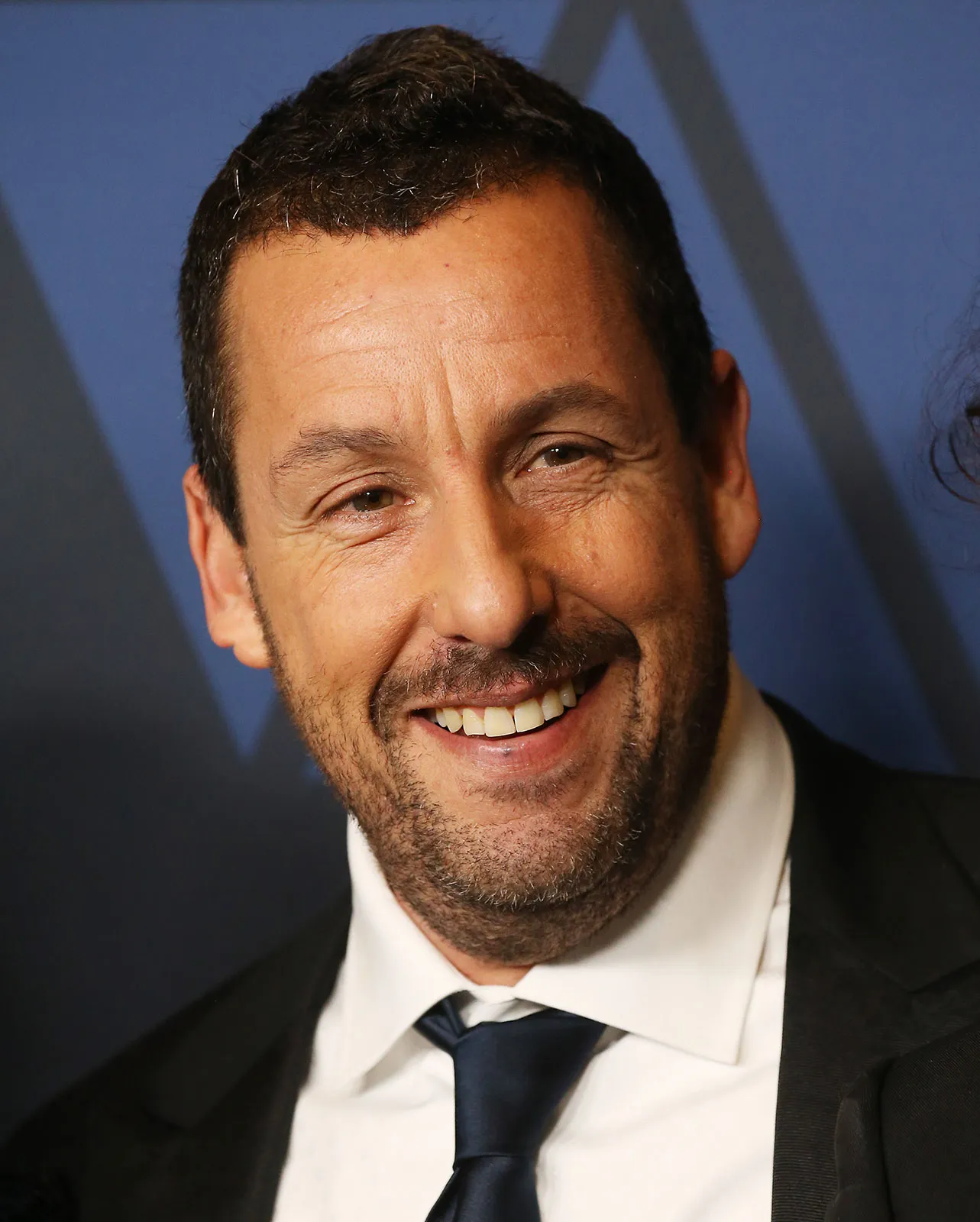
Adam Sandler has spent more than three decades making people laugh with characters who shout, sulk, sing badly and refuse to behave like adults. That description is accurate, but it explains only the surface of his career. Behind the childish voices and deliberately absurd plots sits a performer with sharp instincts for popular comedy, a producer who protects his working relationships, and an actor who has repeatedly surprised audiences when a director asks him to stop playing for laughs. His public persona often looks casual enough to be mistaken for carelessness. In reality, Sandler has built one of Hollywood’s most durable careers by knowing exactly what he enjoys, what his audience will accept, and which collaborators make his work better.
Sandler’s story does not begin in Los Angeles or New York comedy clubs. He was born in Brooklyn in 1966, then moved with his family to Manchester, New Hampshire, when he was five. His father Stanley worked as an electrical engineer, while his mother Judy taught nursery school. He grew up in a Jewish household with three older siblings, and family life gave him a ready supply of voices, rhythms and small frustrations to turn into jokes. The young Sandler was not presented as a polished child actor waiting to be discovered. He was a class clown with enough nerve to test himself in front of strangers.
His first major push came from his brother Scott, who urged him to take the stage at a Boston comedy club when Sandler was still a teenager. Sandler did not arrive with a carefully constructed act. He tried jokes, impressions and the odd comic energy that later became familiar to millions. The reception was strong enough to convince him that performing could be more than an entertaining habit. That early test mattered because it shifted comedy from private family amusement to a job he was willing to chase, even without guarantees.
New York gave Sandler a more demanding place to learn. He attended the Tisch School of the Arts at New York University, graduating in 1988, while taking stand-up work wherever he could get it. The city taught him that a comic voice must survive different rooms, different crowds and the silence after a joke fails. He also appeared in small television roles, including a stint on The Cosby Show as one of Theo Huxtable’s friends. None of those jobs made him famous, but each added experience at a time when many young comics disappear after their first rejection.
Saturday Night Live changed the scale of Sandler’s ambitions, though he did not enter the programme as an obvious star. Dennis Miller saw his stand-up and recommended him to the show. Sandler joined in 1990 as a writer, at a moment when writing staff could disappear behind the cast. He soon became a featured performer, partly because he brought material that sounded unlike the older satirical traditions associated with the programme. His songs were scruffy, catchy and built around subjects that should not have carried a tune: lunch ladies, holiday gifts, bedtime complaints and adolescent anger.
The SNL characters made his oddness legible to a large audience. Opera Man delivered topical jokes in mock operatic Italian; Canteen Boy exaggerated innocence to ridiculous levels; and Sandler’s loud, frustrated characters turned childish complaints into a comic language. His performances divided viewers even then. Some found them irritating, while others repeated the lines at school the next day. Sandler was not trying to please every viewer. He was creating a recognisable comic territory where stupidity could be affectionate, anger could be silly, and songs could be both deliberately crude and unexpectedly warm.
His closest professional friendships formed during those early years. Chris Farley, David Spade, Chris Rock and Rob Schneider were not merely colleagues who appeared in the same sketches. They were young performers navigating a high-pressure institution that could make or end careers quickly. Farley and Sandler shared a particular bond, rooted in their contrasting physical styles and a similar willingness to look foolish. When Farley died in 1997, Sandler carried that loss privately for years before performing a tribute song on his Netflix special 100% Fresh. The song is funny in places, but its real force comes from grief rather than nostalgia.
Being fired from SNL in 1995 could have stalled Sandler’s career. The show dismissed both Sandler and Farley during a period of cast change, and the decision was widely discussed because both had become familiar faces. Sandler later joked about the firing, yet the disappointment was real. He had to decide whether television had been a brief opportunity or the launching point for something larger. The film offered the answer. Rather than wait for a network to invite him back, he chose projects that used his existing audience and gave his comic persona more room.
Billy Madison arrived in 1995 with a premise designed for Sandler’s strengths: an irresponsible rich man must repeat every school year to inherit his father’s company. The film received little critical enthusiasm at the time, but it found its viewers through video, cable and repeated quoting. Happy Gilmore followed in 1996 and made Sandler’s temper more athletic. He played a failed hockey player who discovers he can hit a golf ball with startling force. The film brought together a sports setting, childish rage, an underdog plot and a hero who never learns conventional manners. It also showed that Sandler could turn a narrow comic idea into a character audiences wanted to revisit.
The next stage was less about a single hit than a repeatable model. The Waterboy, Big Daddy, Little Nicky, Mr Deeds and 50 First Dates gave Sandler different settings but a related promise: broad laughs, sentimental stakes and a star who could be ridiculous without becoming cruel. He often played men who had failed to grow up, yet the films rarely punished them for that failure. Instead, they asked the character to become more reliable while preserving the impulse that made him funny. The formula irritated some critics, who treated repetition as proof of laziness. Audiences often saw it as familiarity delivered with fresh details.
Happy Madison Productions turned that popularity into control. The company takes its name from Happy Gilmore and Billy Madison, two early films that proved Sandler could sell a comic brand. Production ownership gave him more than a credit on screen. It allowed him to choose writers, shape casting, arrange locations and create opportunities for people he trusted. The company produced Sandler vehicles, but it also supported films and shows led by friends and newer performers. That structure explains why viewers repeatedly see the same faces around him: Allen Covert, Peter Dante, Nick Swardson, Kevin James, David Spade, Rob Schneider and Steve Buscemi.
Those recurring performers are sometimes treated as evidence of a closed club. They are better understood as Sandler’s working method. Comedy depends on timing, and timing improves when actors know one another’s habits. A familiar cast can arrive on set already aware of which improvisations will escalate a scene and which will ruin its pace. Sandler has said little publicly about creative theory, but his films reveal a practical belief in loyalty. He returns calls, remembers old collaborators and gives them roles that suit their comic instincts. The result can feel like a private joke opened to the public, which is either the attraction or the reason some viewers stay away.
Sandler’s productions also acquired a reputation for mixing work with pleasure. Films have been made in Hawaii, South Africa, Massachusetts, New York, Los Angeles and other places that offer good weather, sport or room for families. The stories about casts playing golf, travelling together and bringing relatives along are not accidental. Sandler has often chosen premises that justify a desirable location, then made the work fit around that choice. It is an unusually direct business model: make a commercial comedy, hire people you like, and let the production schedule contain a life you actually want to live.
That approach does not mean the films cost nothing or run without discipline. Studio comedy has thin margins when it misses, and a producer must keep schedules, crews and budgets under control. Sandler’s films often use contained premises, direct visual storytelling and a star-led marketing hook rather than expensive spectacle. A family holiday comedy can be mounted more predictably than a superhero film. Even the fondly chaotic Grown Ups films rely on a simple proposition: old friends reunite, argue, compete and slowly admit they care about one another. The spectacle comes from personalities rather than destroyed cities.
Critical opinion has rarely matched Sandler’s commercial position. Several of his most profitable comedies received harsh reviews, while fans watched them repeatedly at home and quoted scenes for years. That split has shaped the conversation around him. Reviewers often judge whether a film expands the form, while viewers may simply want a comic performer whose rhythms they already trust. Sandler has not entirely ignored criticism, but he has refused to build his career around winning it. His choices suggest that he values the response of a large, loyal audience more than the approval of a narrow cultural gatekeeper.
The most revealing challenge to the lazy-comedian label came with Paul Thomas Anderson’s Punch-Drunk Love in 2002. Sandler played Barry Egan, a lonely small-business owner with buried rage and seven overbearing sisters. The performance kept Sandler’s nervous energy but stripped away the usual safety net of gags. Barry’s outbursts were frightening, not merely funny, and his need for connection gave the film an ache that surprised viewers who knew Sandler mainly from The Waterboy. Anderson did not ask him to pretend he was a different actor. He used the volatility already present in Sandler’s comic work and placed it in a more exposed setting.
Later dramatic roles confirmed that Punch-Drunk Love was not a fluke. In Reign Over Me, Sandler played a dentist grieving the loss of his family in the September 11 attacks. In The Meyerowitz Stories, he brought resentment and tenderness to a difficult family. In Uncut Gems, made by Josh and Benny Safdie, he became Howard Ratner, a jewellery dealer whose gambling, deception and hunger for a big win push every relationship towards disaster. Sandler makes Howard exhausting, selfish and magnetic. He never asks the audience to forgive the man; he makes them feel why escaping his momentum is so hard.
The awards conversation around Uncut Gems revealed an old tension in Sandler’s career. Critics praised his performance and many expected an Academy Award nomination, but it did not come. Sandler responded with a joke on social media that he would make an intentionally terrible film if he were snubbed. The post sounded like classic Sandler, deflecting disappointment through comedy. It also showed why he has lasted. He can seek demanding work without treating prestige as a verdict on his worth. A nomination would have mattered, but it would not have erased the audience he had already built.
Basketball is another constant thread in Sandler’s life. He has played pickup games for years, appears in casual basketball clothes with striking regularity, and often places the sport in his films. Hustle, his 2022 drama about a basketball scout, gave him an opportunity to turn that personal interest into a more grounded role. He played Stanley Sugerman with a worn-down patience that differs from the usual Sandler hero. The film’s training scenes and arguments about talent feel credible because Sandler understands the pleasure of the game, the language around it and the stubborn optimism of people who keep playing after work.
His clothing has become its own quiet joke. At premieres, courtside seats and public outings, Sandler often wears oversized T-shirts, baggy shorts, trainers and practical hoodies. Fashion writers have turned the look into a recurring subject, partly because it rejects the usual celebrity uniform of calculated polish. Sandler seems comfortable with the attention but not interested in changing the habit. The clothes match a larger refusal to perform status. They also leave room for a more useful reading: a person who spends time with children, friends and basketball games does not need a restrictive costume to prove he belongs in Hollywood.
The family remains close to Sandler’s work without becoming a constant public spectacle. He married actor Jackie Sandler in 2003, and they have two daughters, Sadie and Sunny. Jackie has appeared in many of his films, sometimes in small roles that attentive viewers spot after the fact. Their daughters have also appeared in projects as they have grown older. Sandler does not hide his family, but he avoids turning domestic life into a permanent promotional tool. That restraint is notable in an industry where exposure can easily become part of a brand.
Sandler’s music offers another route into his personality. His comedy albums, including They’re All Gonna Laugh at You! and What the Hell Happened to Me?, sold strongly in the 1990s because they gave fans material that felt less polished than a film. The songs mix nonsense with ordinary feelings. ‘The Chanukah Song’ began as a playful correction to Christmas-heavy pop culture, yet it became a seasonal staple for many Jewish listeners. ‘Grow Old with You’, written for The Wedding Singer, works because it is simple rather than clever. Sandler understands that a joke song can suddenly become sincere if the melody and sentiment are allowed to breathe.
His generosity has entered public discussion through anecdotes rather than a carefully managed charitable image. Cast members from Grown Ups have spoken about gifts and bonuses, including reports of new cars for some colleagues. Sandler has also supported organisations connected with children, health and community causes. It is worth keeping those stories in proportion: celebrity generosity can be amplified into mythology quickly. Yet the repeated theme is consistent with his career choices. He appears to use success not only to protect himself, but to keep a circle of people employed and included.
Netflix extended Sandler’s reach when the company signed a multi-picture deal with Happy Madison in 2014 and later renewed the relationship. The partnership made sense for both sides. Netflix wanted recognisable films with a global audience, while Sandler wanted a distributor that valued viewing figures more than opening-weekend prestige. The arrangement produced broad comedies such as Murder Mystery and You Are So Not Invited to My Bat Mitzvah, alongside projects that gave his family and friends more screen time. Streaming also suited his audience, many of whom had already turned earlier films into home-viewing favourites.
The Netflix years have not been one-note. Hustle showed that Sandler could lead a sports drama without abandoning his accessible style, while You Are So Not Invited to My Bat Mitzvah placed him in a father role beside Jackie, Sadie and Sunny. The latter film has a gentler, more observant tone than many Happy Madison comedies. Its attention to teenage embarrassment, family rituals and school rivalry suggests that Sandler’s best work does not always require an outrageous voice. Sometimes he is most convincing when he plays the person who notices the chaos and tries, imperfectly, to manage it.
Sandler’s appeal also rests on his skill at making embarrassment familiar. His characters miss social cues, lose their tempers, speak too loudly and fall in love with more confidence than judgement. Many comic stars play people viewers want to become. Sandler often plays people viewers recognise in their least graceful moments. The point is not that he makes awkwardness noble. He makes it survivable. A poor decision becomes a story; a public humiliation becomes a song; a fight can end with a hug or an absurdly committed sports challenge.
His films have occasionally used ordinary objects and places to ground exaggerated comedy. A cheap meal, a school corridor, a golf course or a suburban kitchen can become the centre of a scene because the characters bring their baggage into it. In one of his gentler films, even restaurant tables and chairs can frame a family disagreement, a first date or a reconciliation without demanding attention for themselves. Sandler’s humour works best when the setting feels close enough to daily life that one disruptive person can make it ridiculous.
His influence on modern comedy is easy to underestimate because his work rarely asks to be treated as grand art. He helped establish a route from sketch comedy to producer-led film careers, where a performer can keep a recognisable voice while gaining control over casting and distribution. He also proved that a comic actor can move into serious drama without announcing a reinvention. The shift works when a director finds the anxiety, temper or sadness already embedded in the familiar persona. Sandler did not need to discard the goofy voice to become interesting; he needed the right films to reveal what sat behind it.
His career has had failures, awkward experiments and films that feel made chiefly for the people on set. That imperfection is part of the point. Sandler has not built a reputation by chasing a spotless filmography or adapting himself to every fashion in comedy. He has built it through persistence, trust and a clear sense of what makes him laugh. When he takes a dramatic role, the surprise still carries weight because he has spent so long refusing to become predictable in the approved way.
Adam Sandler therefore remains more complicated than the caricature of a star in baggy shorts making easy jokes with friends. He is a disciplined popular entertainer who learned early that a bad joke can be repaired, a setback can become material, and loyalty has commercial value as well as emotional value. His life contains the familiar ingredients of celebrity: wealth, fame, awards talk and public scrutiny. His career feels distinctive because he has treated those ingredients as secondary to the next joke, the next song, the next game of basketball and the next chance to work with people who were there before the money arrived.
That balance explains why his reputation survives both bad reviews and changing platforms: people sense that the laid-back image is genuine, but so is the determination beneath it. Sandler has made his rules, then accepted responsibility for the results.
