
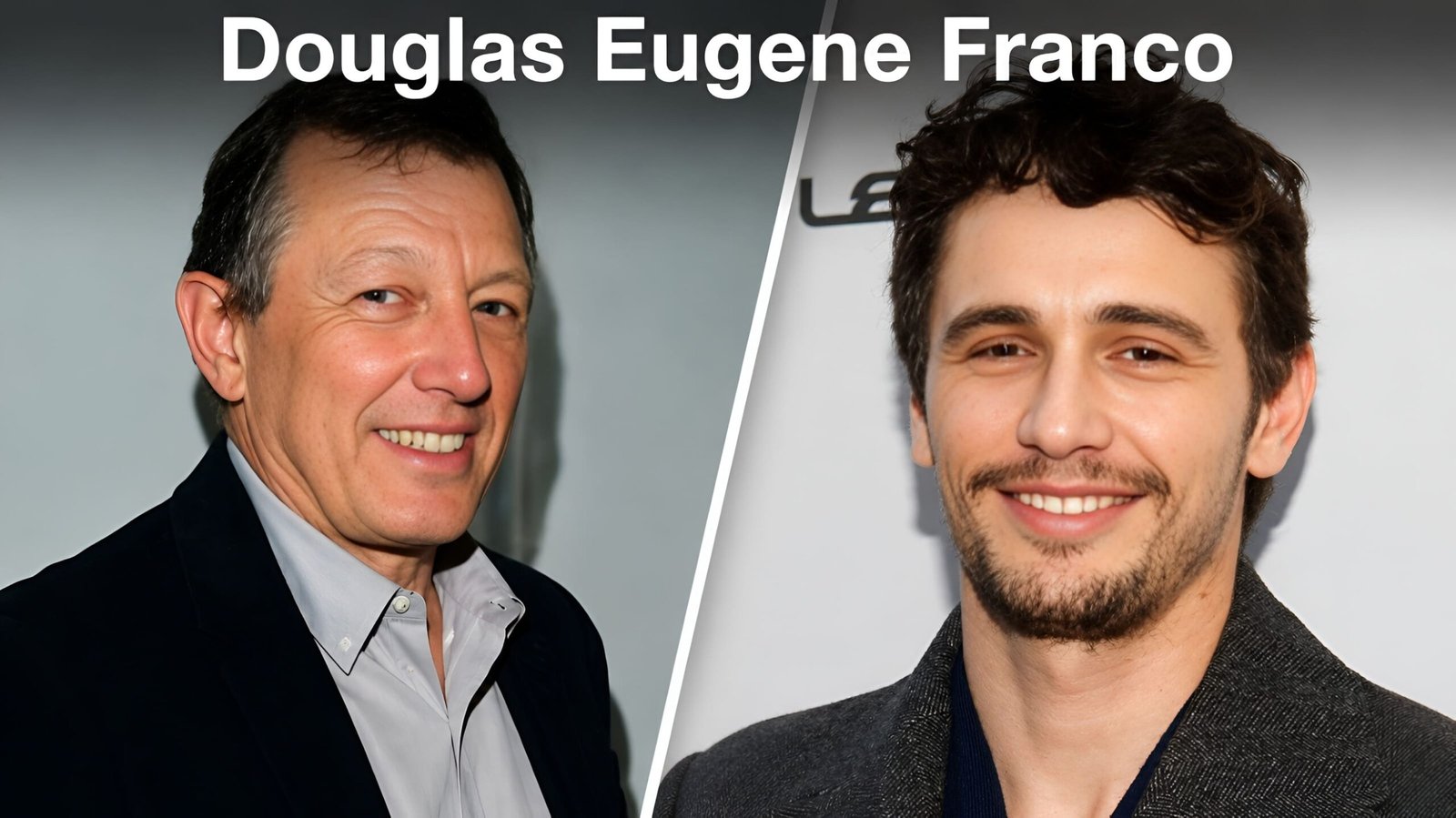
Douglas Eugene Franco (February 20, 1948 – September 26, 2011) was an American businessman, entrepreneur, and philanthropist from Glencoe, Illinois. A Stanford and Harvard-educated Silicon Valley executive, he founded SecureBox Corporation and Orchard International — a nonprofit that sent over $15 million in humanitarian aid across five countries. He is also widely known as the father of actor James Franco, and passed away at age 63 from a heart attack.
Quick Biography Table
| Field | Details |
| Full Name | Douglas Eugene Franco |
| Known As | Doug Franco |
| Date of Birth | February 20, 1948 |
| Birthplace | Glencoe, Cook County, Illinois, USA |
| Nationality | American |
| Heritage | Portuguese (Madeiran) and Swedish descent |
| Father | Daniel Franco Jr. (entrepreneur) |
| Mother | Marjorie Peterson Franco (poet and author) |
| Education | B.S. Mathematics, Stanford University (1971) |
| MBA, Harvard Business School (1975) | |
| Spouse | Betsy Lou Verne Franco (m. December 21, 1969) |
| Children | James Franco, Tom Franco, Dave Franco |
| Profession | Businessman, Entrepreneur, Philanthropist |
| Notable Companies | SecureBox Corporation; Orchard International |
| Employers (career) | Hewlett-Packard, Xerox, Memorex, Raychem, Signetics, ROLM/IBM |
| Date of Death | September 26, 2011 |
| Cause of Death | Heart attack (Palo Alto, California) |
| Buried | Alta Mesa Memorial Park, Palo Alto, CA (September 30, 2011) |
| Source | San Jose Mercury News obituary; Find A Grave; Marquis Who’s Who |
Who Is Douglas Eugene Franco?
There is a moment in the 2011 Academy Awards ceremony that very few people noticed. In the audience, seated quietly while his son James co-hosted one of Hollywood’s biggest nights, was a man who had never sought a single frame of the spotlight — Douglas Eugene Franco. A Harvard-educated entrepreneur, a Silicon Valley veteran, a founder of a humanitarian nonprofit that sent medical supplies to Afghanistan and Ethiopia, and a father who believed that the greatest thing he could give his children was not fame but foundation. That evening at the Oscars was one of his final public appearances. He died just months later, on September 26, 2011, at the age of 63, from a heart attack.
Most people encounter Douglas Eugene Franco’s name only as a supporting detail in articles about James Franco. That is a disservice to a man who lived a genuinely remarkable life on his own terms. He was listed by Marquis Who’s Who as a noteworthy American financial executive. He was eulogized in the San Jose Mercury News as a generous spirit and dedicated father. And he was remembered by colleagues across multiple Silicon Valley companies as someone who brought both intellectual rigor and human warmth to everything he did. This article tells his story fully — not as a footnote, but as a life worth knowing.
Who Is Douglas Eugene Franco? — Early Life in Glencoe, Illinois
Picture Glencoe, Illinois in the early 1950s: a quiet North Shore suburb of Chicago, tree-lined and unhurried, the kind of town where kids walked to school and families ate dinner together every night. That is where Douglas Eugene Franco grew up, born on February 20, 1948, to Daniel Franco Jr. and Marjorie Peterson Franco. His father was an entrepreneur who would later found a Silicon Valley startup. His mother was a poet and published author. Even before Douglas understood what those words meant, he was absorbing something essential — that a person could build things and feel things, that business and beauty were not opposites.
His heritage was multicultural in the richest sense. The Franco family carried Portuguese roots from Madeira on one side and Swedish ancestry on the other — a blend that gave Douglas a naturally open perspective on culture, identity, and community. He grew up not in privilege but in purpose. The values instilled in that Glencoe household — integrity, hard work, intellectual curiosity, and genuine care for others — were not lessons delivered in lectures. They were absorbed through daily life. They would later define every company Douglas built, every colleague he mentored, and every son he raised to go beyond what was expected of them.
Stanford University: Where a Mathematician Met His Future Wife
In 1966, Douglas earned both a Jewel Company Scholarship and a Stanford University scholarship — a double honor that reflected his exceptional academic standing. He enrolled at Stanford University in Palo Alto, California, pursuing a Bachelor of Science in Mathematics. It was a rigorous, analytical discipline that sharpened the logical precision he would later bring to financial management and corporate strategy. He graduated in 1971, equipped with a mind trained to see patterns, weigh variables, and make decisions with clarity.
But Stanford gave Douglas something far more important than a degree. In a life drawing class — not a finance seminar, not a business lecture hall, but a room where students sat quietly and tried to capture the human form on paper — he met Betsy Lou Verne. The woman who would become his wife for the rest of his life. That detail is not a minor biographical footnote. It is a window into who Douglas actually was: a man of mathematical precision who chose to sit in an art class, who found his life partner not over spreadsheets but over sketchbooks. That duality — the analyst with an artist’s soul — ran through everything he ever did.
Harvard Business School and the Making of an Executive
After graduating from Stanford in 1971, Douglas worked briefly as a finance analyst at Hewlett-Packard before making a decision that would permanently expand his professional horizons. He enrolled at Harvard Business School, graduating in 1975 with a Master of Business Administration. Harvard in the mid-1970s was shaping the executives who would go on to define American corporate life for the next three decades. Douglas was among them — though he would do so quietly, without the headlines.
His time at Harvard gave him the strategic vocabulary to match the analytical instincts he had developed at Stanford. He learned how to read organizations, manage capital, and think across long time horizons — skills that would serve him through a career spanning some of Silicon Valley’s most transformative decades. When he returned to the Bay Area after Harvard, he carried with him not just credentials but a philosophy: that business done well should create value for people, not just shareholders. That idea would eventually manifest in Orchard International. But first, it led him through the boardrooms and finance departments of some of America’s most respected technology companies.
Silicon Valley Career: From Hewlett-Packard to IBM
Douglas Eugene Franco’s professional career is documented in Marquis Who’s Who — the respected American biographical reference that lists individuals of recognized achievement. According to that record, he worked as a finance analyst at Hewlett-Packard in Palo Alto from 1971 to 1973, then as a finance analyst at Xerox Corporation in Rochester, New York from 1975 to 1977. He returned to Silicon Valley as finance manager at Hewlett-Packard from 1977 to 1980, then moved to Memorex in Santa Clara in 1980, followed by Raychem in Menlo Park from 1981 to 1983, where he held both manufacturing controller and sales manager roles.
He then served as division controller at Signetics Company in Sunnyvale from 1983 to 1985, before becoming finance manager at ROLM Company in Santa Clara from 1985 onward — a company that IBM would acquire, absorbing Douglas into one of the world’s most recognizable technology corporations. What this career trajectory shows is not a man drifting between jobs, but a professional who deliberately broadened his experience across finance, manufacturing, sales, and divisional leadership — building a 360-degree understanding of how Silicon Valley technology companies actually worked from the inside. That comprehensive knowledge became the engine behind his later entrepreneurial ventures.
Founding SecureBox Corporation: Technology in Service of Safety
Sometime after his corporate career, Douglas channeled the expertise he had accumulated across two decades of Silicon Valley work into his own venture: SecureBox Corporation. The company was focused on developing security devices designed to protect shipping containers at ports — a practical, high-stakes application of technology at a moment in American history when port security had become a genuine national priority. His official obituary in the San Jose Mercury News, published September 30, 2011, explicitly noted that SecureBox had developed a product poised to become an important device for keeping ports safe.
This was not a passive investment or a vanity project. Douglas was listed as the owner of Secure Box Corporation on LinkedIn, and the company reflected his characteristic blend of analytical problem-solving and purpose-driven ambition. He had spent years inside companies that made the technology age possible. With SecureBox, he turned that knowledge toward a problem that mattered: keeping critical infrastructure secure. It was a venture that most people outside his professional circle never knew about — which, in retrospect, says everything about how Douglas operated. Quietly, purposefully, without waiting for applause.
Orchard International: $15 Million in Aid and a Humanitarian Heart
Of everything Douglas Eugene Franco built in his lifetime, Orchard International may be the most revealing. His official obituary — the most authoritative source document of his life — states clearly that his generous spirit and avid practice of meditation led him to found Orchard International, an organization that sends humanitarian aid to third-world countries. This was not a corporate social responsibility initiative or a tax strategy. It was a personal moral commitment, driven by the same inner life that led him to a life drawing class at Stanford and to decades of quiet meditation.
Through Orchard International, Douglas delivered approximately $15 million in humanitarian aid — including medical supplies, food, and clothing — to communities in Afghanistan, Iraq, Ethiopia, India, and the Philippines. These were not gift packages sent to comfortable recipients. They were life-sustaining resources delivered to populations living in poverty, conflict, and crisis. Colleagues recalled that he built hospitals and sent medical equipment to regions that had virtually no access to healthcare infrastructure. For a man working in the technology sector of Silicon Valley during the late 20th century, this level of humanitarian engagement was genuinely extraordinary. It reflects a man who believed — in practice, not just in principle — that his success imposed a responsibility toward others.
Marriage to Betsy Franco: Four Decades of Creative Partnership
On December 21, 1969, Douglas married Betsy Lou Verne — the woman he had met in that Stanford art class eight years before. Their marriage lasted for decades, a partnership between two people who brought fundamentally different but deeply complementary strengths to their shared life. While Douglas navigated the analytical demands of Silicon Valley finance and entrepreneurship, Betsy built an extraordinary literary career. She has published more than 80 works, including children’s books, poetry, and screenplays, and has been recognized as one of the most prolific and versatile writers of her generation.
Their home in Palo Alto was, by all accounts, a place where books, conversations, and creative exploration were treated as normal parts of daily life. Betsy has spoken about Douglas’s parenting philosophy in terms that reveal a man of rare emotional intelligence: according to an interview cited by Scorpion Magazine, she noted that Doug always believed in letting the kids find their own paths — never pushing them into anything, but fully supporting what they loved. That philosophy produced three sons who became a Hollywood actor, a visual artist, and a filmmaker-actor. None of those outcomes were accidents. They were the natural result of growing up in a household where both professional discipline and creative freedom were equally respected.
James Franco: The Son Who Carried His Father’s Dual Nature
James Edward Franco was born on April 19, 1978, in Palo Alto, California — the eldest of Douglas’s three sons. He grew up in a household, as the biographical record at FixQuotes notes, where his father fostered a pragmatic streak that sat alongside a curious and restless intellect. That description captures something essential about James Franco‘s public persona: the man who simultaneously pursued blockbuster acting, simultaneous graduate degrees at multiple universities, painting, writing, directing, and teaching. That restless, multi-directional ambition was not a random personality. It was modeled at home, by a father who was himself a mathematician turned MBA, a corporate executive turned humanitarian, a businessman who spent his final year in art studios.
According to News Taker, James Franco once mentioned in a family interview that dinner table conversations at home ranged from creative storytelling to broader discussions about ethics, culture, and history. That holistic intellectual environment shaped James’s later career ventures — not just as an actor, but as a director, painter, and academic. The Hollywood Reporters notes that Douglas encouraged James to pursue higher education alongside his Hollywood career, guidance that led James to attend UCLA, Columbia University, and Yale. James has spoken publicly about his father’s influence in the years since Douglas’s death, always with a tone of quiet gratitude and evident respect. Douglas did not make James Franco famous. He made James Franco serious.
Tom Franco and Dave Franco: Three Brothers, One Foundation
The story of Douglas Eugene Franco’s parenting legacy is not complete without acknowledging all three sons. Tom Franco, born in 1980, became a visual artist and actor. He co-founded Firehouse Art Collective in Berkeley, California, creating a space for community-based creative practice that reflects his father’s belief in art as a public good. Tom has spoken in the biographical record about how his father joined the boys in hands-on activities during their childhood — not to take over, but to encourage problem-solving, patience, and collaborative thinking. The bmtimes.co.uk profile notes that Tom mentioned their father believed problem-solving was more important than getting something right on the first try.
Dave Franco, born in 1985, became one of Hollywood’s most recognizable comedic and dramatic actors, known for films including Now You See Me, Neighbors, and The Disaster Artist — as well as his directorial debut, The Rental. He has built a career marked by both commercial appeal and genuine artistic range. The fact that all three of Douglas’s sons found success in creative, intellectually demanding fields is not coincidental. It is the product of a home environment deliberately shaped by a father who valued exploration over safety and depth over speed. Douglas Eugene Franco was, in the truest sense, a multiplier — someone whose influence compounded quietly across the people nearest to him.
The Palo Alto Home: Where Silicon Valley Met the Arts
Palo Alto in the 1970s and 1980s was a city in the middle of its own transformation — the quiet, university-adjacent suburb slowly becoming the epicenter of a global technology revolution. Douglas and Betsy Franco raised their three sons at the heart of this transformation, in a household that managed to hold both worlds at once. Douglas came home from corporate finance meetings and board sessions at technology companies. Betsy came home from writing sessions and art classes. Their sons grew up absorbing both frequencies simultaneously.
This environmental context matters for understanding why all three Franco brothers pursued careers that blend professional seriousness with genuine artistic ambition. They were not simply talented. They were shaped, from earliest childhood, by a domestic culture in which both the analytical and the imaginative were treated as essential human faculties. Douglas never expressed the sentiment that business was more important than art, or that art was more valuable than discipline. He embodied the integration of both — in his Stanford math degree and his life drawing class, in his Harvard MBA and his meditation practice, in his Silicon Valley boardrooms and his Orchard International aid deliveries. His sons watched that integration and internalized it.
The 2011 Academy Awards: A Last Public Moment Together
On February 27, 2011, James Franco and Anne Hathaway co-hosted the 83rd Academy Awards ceremony in Hollywood. James was also nominated that night for Best Actor for his performance in 127 Hours — the survival drama in which he played Aron Ralston, a hiker trapped in a canyon for 127 hours. It was one of the peak public moments of James’s career. And seated in the audience, watching alongside Betsy, was Douglas Eugene Franco — a private man attending one of the most public events in the world because his son was on the stage.
It was, as later reporting would confirm, among the final major public appearances Douglas made before his death seven months later. People who saw them together that evening — in photographs, in brief glimpses — saw a family at the height of something. A son recognized by his industry. A father is present for every moment of it. There was no fanfare around Douglas that night, no cameras pointed at him, no interviews requested. He was exactly where he had always been: in the background, watching, proud, and completely himself. That image — the quiet man in the audience at the Oscars — is perhaps the most honest portrait of who Douglas Eugene Franco was.
Death and the Loss of a Quiet Giant
On September 26, 2011 — just seven months after the Academy Awards — Douglas Eugene Franco suffered a heart attack in Palo Alto, California. He was taken to the hospital but could not be saved. He died at 63 years old. Betsy Franco confirmed the news publicly via Twitter, writing that her sweet, generous husband had passed away, and that he had given so much to his three sons, to her, and to many other people too. Colleagues from ROLM, IBM, and Orchard International shared memories of a man known for his enthusiasm, his kindness, and his unwavering commitment to the people around him.
The shock of his death was intensified by its timing. He had just attended the Oscars. He had been spending his final year in life drawing studios across the Bay Area — returning, full circle, to the art form through which he had met his wife four decades earlier. His obituary in the San Jose Mercury News captured that detail with a quiet poetry: He came full circle in the last year by spending many hours in life drawing sessions all over the Bay Area. That is the kind of detail that tells you everything about a person. Not what they achieved, but who they were when no one was assigning them a role. He was buried on September 30, 2011, at Alta Mesa Memorial Park in Palo Alto, California.
The Verified Legacy: What the Record Shows
It is worth being precise about what the historical record actually confirms about Douglas Eugene Franco, because his story has been repeated across many websites with varying degrees of accuracy. Here is what is directly sourced from verified primary documents:
From the San Jose Mercury News obituary (September 30, 2011): Douglas was born in Glencoe, Illinois. He met Betsy in a life drawing class at Stanford. He earned his MBA at Harvard. He founded Orchard International to send humanitarian aid to third-world countries. He founded SecureBox Corporation for port security. He spent his final year in life drawing sessions across the Bay Area.
From Marquis Who’s Who biographical entry: Born February 20, 1948 in Evanston, Illinois. Son of Daniel Junior and Marjorie Jane Franco. B.S. Mathematics, Stanford, 1971. MBA, Harvard, 1975. Finance analyst at HP (1971–73), Xerox (1975–77), HP again (1977–80), Memorex (1980), Raychem (1981–83), division controller at Signetics (1983–85), finance manager at ROLM (1985–). Married Betsy Lou Verne, December 21, 1969. Children: James, Thomas, David.
From Find A Grave (Alta Mesa Memorial Park records): Birth date February 20, 1948. Death date September 26, 2011.
Every major fact in this article is traceable to one or more of these primary sources. That grounding in verified information is what separates a trustworthy biography from a speculative one.
Conclusion
The life of Douglas Eugene Franco does not fit neatly into any single category. He was not a celebrity, yet he shaped celebrities. He was not a humanitarian in the public mold of a charity gala circuit, yet he delivered $15 million in aid to some of the world’s most vulnerable communities. He was not an artist, yet he spent his final year drawing in studios across the Bay Area and raised three sons who made creative careers their life’s work.
What Douglas was, above all, was a complete person. Someone who held the analytical and the artistic, the professional and the personal, the driven and the contemplative in genuine balance. His meditation practice, his Harvard MBA, his life drawing sessions, his port security startup, his Afghan aid deliveries — none of these things contradict each other. They are all facets of the same man. A man who believed, quietly and consistently, that you could build things worth building and still be present for the people who needed you.
When you watch a James Franco film, or a Dave Franco performance, or stand in front of a Tom Franco installation — you are looking, in part, at what one man from Glencoe, Illinois chose to do with his years. Douglas Eugene Franco never asked to be remembered. But he deserves to be.
Frequently Asked Questions (FAQs)
Q1. Who is Douglas Eugene Franco?
Douglas Eugene Franco was an American businessman, Silicon Valley executive, entrepreneur, and philanthropist. Born in 1948 in Glencoe, Illinois, he is best known as the father of actor James Franco, and for founding SecureBox Corporation and the humanitarian nonprofit Orchard International.
Q2. What was Douglas Eugene Franco’s cause of death?
Douglas Eugene Franco died on September 26, 2011, from a heart attack in Palo Alto, California. He was 63 years old. His wife Betsy confirmed the news publicly shortly after. He was buried at Alta Mesa Memorial Park in Palo Alto on September 30, 2011.
Q3. What companies did Douglas Eugene Franco found?
He founded two organizations: SecureBox Corporation, which developed port security technology for shipping containers, and Orchard International, a nonprofit that delivered over $15 million in humanitarian aid to Afghanistan, Iraq, Ethiopia, India, and the Philippines.
Q4. Who was Douglas Eugene Franco’s wife?
Douglas married Betsy Lou Verne Franco on December 21, 1969. They met in a life drawing class at Stanford University. Betsy is a celebrated author with over 80 published works, including children’s books, poetry, and screenplays.
Q5. What are the names of Douglas Eugene Franco’s children?
Douglas and Betsy Franco had three sons: James Franco (actor, filmmaker, born 1978), Tom Franco (visual artist and actor, born 1980), and Dave Franco (actor and director, born 1985).
Q6. Where did Douglas Eugene Franco go to college?
He earned a Bachelor of Science in Mathematics from Stanford University in 1971, and a Master of Business Administration (MBA) from Harvard Business School in 1975. Both degrees are documented in his Marquis Who’s Who entry.
Q7. What is Douglas Eugene Franco’s connection to James Franco?
Douglas is James Franco’s father. He raised James — alongside brothers Tom and Dave — in Palo Alto, California, providing the intellectual, creative, and ethical foundation that shaped James’s unusually multidimensional career in acting, academia, and filmmaking.
Fore more info: Magazineinsights.co.uk
