
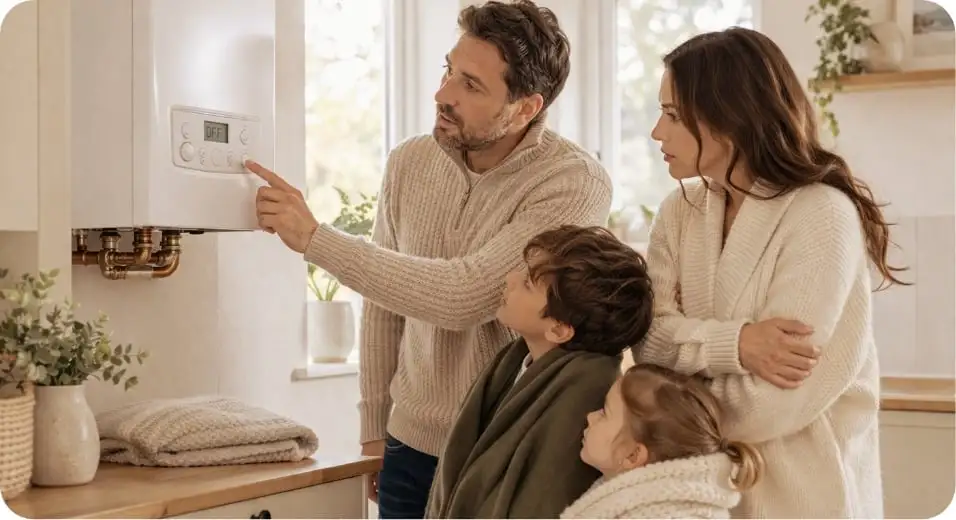
A Glow Worm boiler that won’t fire up is usually down to one of seven things: no power, low system pressure, a closed gas valve, a frozen condensate pipe, a faulty fan, a worn spark electrode, or a stuck diverter valve. Power, pressure, and a frozen pipe are checks you can do yourself in minutes. Anything involving the gas valve, fan, or ignition parts needs a Gas Safe registered engineer.
Few things ruin a morning faster than pressing the thermostat and getting nothing back. The display might be blank, it might light up and do nothing, or the boiler might click away without ever catching. Each pattern points to a different cause, and most of them are quicker to fix than you’d think.
Before calling anyone out, it helps to work through the usual suspects in order, starting with the simple stuff. Most glow worm boiler problems that stop the appliance firing up trace back to one of seven causes, and four of them you can rule in or out yourself without touching a single internal component.
1. No Power Reaching the Boiler
If the display is completely blank, start here. Check the fused spur switch near the boiler is on, check the fuse itself hasn’t blown, and check nothing has tripped at the consumer unit.
A boiler with no lights at all almost never means an internal fault. It usually means the power supply has been interrupted somewhere between the wall and the appliance.
2. Low System Pressure
This is the single most common reason a Glow Worm won’t fire. Pressure should sit between 1 and 1.5 bar on the gauge. Anything lower and the boiler may refuse to fire as a safety precaution.
How to Check and Fix Low Pressure
1. Look at the pressure gauge on the front of the boiler while it’s cold.
2. If it reads below 1 bar, find the filling loop, usually a flexible hose under the boiler.
3. Open the valves slowly until the gauge reaches 1 to 1.5 bar, then close them firmly.
4. Reset the boiler and check it fires.
Pressure that keeps dropping points to a leak somewhere in the system or radiators that need bleeding, and that’s worth flagging to an engineer even if the immediate fix worked.
3. A Closed or Faulty Gas Valve
No gas means no flame, regardless of how well everything else is working. Check the gas valve near the meter is fully open. If it is, and the boiler still won’t catch, the internal gas valve inside the appliance may have failed, which is not something to investigate yourself.
4. Frozen Condensate Pipe
This one is seasonal. The white plastic pipe that runs outside carries condensation away from the boiler, and in freezing weather it can ice up and block completely.
The boiler worked fine in autumn, then stopped during a cold snap, often showing a fault code rather than just sitting silent. Pouring warm, not boiling, water over the exposed section of pipe usually clears it within a few minutes.
5. Faulty Fan or Blocked Flue
The fan clears exhaust gases safely before the boiler will allow ignition. If it’s not spinning, sounding rough, or the flue terminal outside is obstructed, the boiler will refuse to fire as a built in safety check.
This is not a DIY repair. A blocked or faulty flue system can be dangerous, and it needs a Gas Safe registered engineer to inspect and clear or replace.
6. Worn Spark Electrode or Ignition Lead
Hear clicking but no flame? That’s usually the ignition system trying and failing. The spark electrode wears down over years of use, and a weak or dirty one won’t generate enough spark to light the gas reliably.
Engineers test this with a multimeter and replace the part if it’s out of tolerance. It’s a relatively cheap fix once diagnosed, but not something to attempt without the right tools and gas safety training.
7. Stuck Diverter Valve or Weak Pump
Boiler fires, runs for a few seconds, then cuts out? That pattern often means heat isn’t leaving the boiler fast enough, which can come from a diverter valve stuck between hot water and heating, or a pump that’s lost power.
If hot water works fine but heating doesn’t fire properly, that’s a strong clue pointing at the diverter valve rather than the pump.
Symptom Checker: Match Your Issue to the Cause
| Symptom | Likely Cause | Can You Fix It Yourself? |
| No lights or display at all | No power, tripped switch, blown fuse | Yes, check fuse and switch first |
| Display on but boiler stays cold | Low pressure or closed gas valve | Yes, check pressure and valve |
| Clicking but never ignites | Faulty spark electrode or gas valve | No, needs an engineer |
| Fan won’t spin or sounds odd | Faulty fan or blocked flue | No, needs an engineer |
| Fires briefly then cuts out | Stuck diverter valve or weak pump | No, needs an engineer |
| Works in summer, fails in winter | Frozen condensate pipe | Yes, thaw with warm water |
| Fault code flashing, won’t reset | PCB issue or repeat lockout | No, needs an engineer |
How Do I Know If It’s a DIY Fix or Needs an Engineer?
Power, pressure, and a frozen condensate pipe are safe to check and fix yourself. Anything involving the gas valve, fan, flue, ignition electrode, pump, or diverter valve needs a Gas Safe registered engineer, both for safety and because these parts require specialist tools to test properly.
Preventing Future Lockouts
A boiler that won’t fire is rarely a one-off. Most repeat issues come from a system that hasn’t been serviced in a while or has been quietly losing pressure for months.
• Book an annual service to catch wear before it causes a lockout.
• Insulate or lag any exposed section of the condensate pipe before winter.
• Check pressure monthly and top up small drops early.
• Get any recurring fault code looked at rather than just resetting through it.
Proper Glow Worm boiler service and repair work covers exactly this, catching the wear on fans, electrodes, and valves before they leave you with no heating on a cold morning.
Frequently Asked Questions
1. Why has my Glow Worm boiler stopped firing up with no fault code showing?
No fault code usually points to a power issue, low pressure, or a closed gas valve, since these are basic conditions checked before the boiler even attempts ignition. Work through power and pressure first before assuming a deeper fault.
2. Why does my Glow Worm boiler click but not ignite?
Clicking without ignition almost always means the spark electrode is worn, dirty, or misaligned, or the gas valve isn’t opening properly. Both need an engineer to test and replace.
3. Can a frozen pipe stop my Glow Worm boiler from working?
Yes. A frozen condensate pipe is one of the most common winter causes of boiler lockouts. Thawing it with warm water usually restores normal operation within minutes.
4. How much does a Glow Worm boiler repair cost?
Cost depends entirely on the cause. A pressure top up costs nothing if done yourself, while parts like a fan, gas valve, or PCB replacement carried out by an engineer will cost more, with prices varying by part and region.
5. Is it safe to keep trying to reset my boiler?
A single reset after basic checks is fine. Repeated resets without fixing the underlying cause is not recommended, since it can hide a worsening fault and put more strain on already failing components.
6. What does it mean if the display stays blank?
A blank display almost always means the boiler isn’t receiving power. Check the fused spur, the fuse itself, and the consumer unit before assuming there’s an internal fault.
7. Why does my boiler work for a few seconds then shut off?
This pattern usually points to a stuck diverter valve or a weak circulation pump, both of which prevent heat from moving away from the heat exchanger fast enough. An engineer will need to inspect and replace the faulty part.
Final Thoughts
A boiler that won’t fire up feels like a bigger problem than it usually is. Power, pressure, and a frozen pipe account for a large share of call outs, and all three are checks you can run yourself in under ten minutes.
Once you’ve ruled those out, stop guessing. Ignition components, valves, and fans involve gas and electrics that need proper testing equipment and a Gas Safe registration to work on safely.
If your checks haven’t solved it, 0800 Homefix has Gas Safe registered engineers who handle Glow Worm boiler faults and repairs every day, getting your heating back on without trial and error.
