
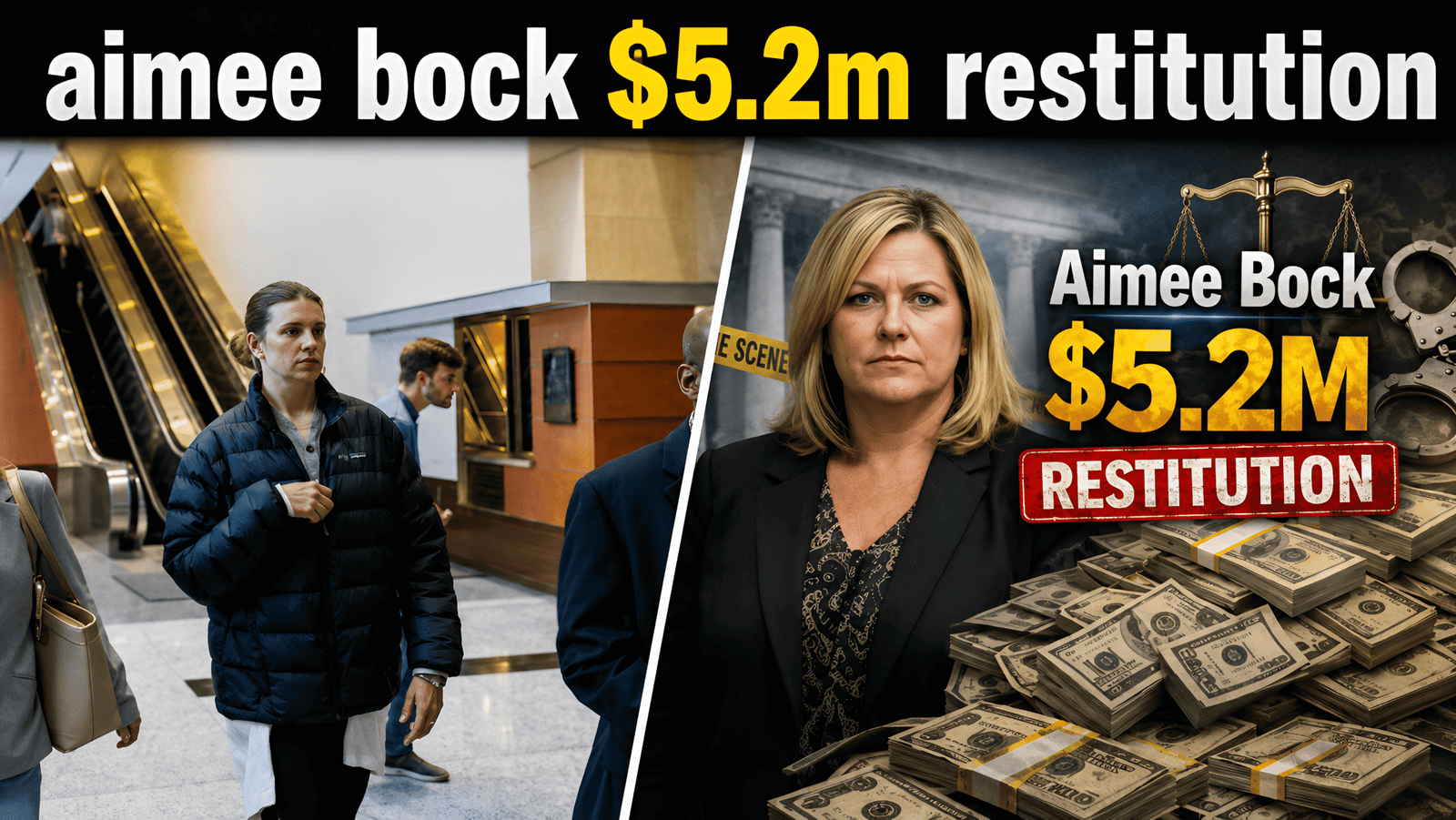
Aimee Bock was ordered to repay about $5.2 million after being convicted in the Feeding Our Future fraud case. Prosecutors said she played a key role in misusing federal child nutrition funds during the COVID-19 pandemic, making it one of the largest fraud scandals tied to emergency relief programs in U.S. history.
Quick Bio Table: Who Is Aimee Bock?
| Full Name | Aimee Bock |
| Age | 45 (as of 2025) |
| Nationality | American |
| Organization Founded | Feeding Our Future (2016) |
| Role | Founder & Executive Director |
| Charges | Wire fraud conspiracy, federal programs bribery |
| Verdict | Guilty on all counts (March 19, 2025) |
| Restitution Ordered | $5,241,522.79 |
| Total Fraud Amount | ~$250 million |
| Status | In custody; awaiting sentencing |
| Co-defendant | Salim Ahmed Said (Safari Restaurant) |
Who Is Aimee Bock?
Aimee Bock is a Minnesota nonprofit executive who founded Feeding Our Future in 2016. The organization presented itself as a charity focused on feeding underserved children through federal nutrition programs. For years, Bock publicly appeared to be a community advocate, but federal investigators later accused her of leading what became the largest pandemic-related fraud scheme prosecuted in U.S. history, involving nearly $250 million in stolen funds.
From Nonprofit Founder to Federal Defendant
Before the scandal exploded, Bock aggressively expanded Feeding Our Future, bringing in hundreds of new meal distribution sites across Minnesota. When the Minnesota Department of Education began raising flags about the suspicious surge in meal counts and financial claims, Bock did not quietly comply — she fought back. She sued the state, publicly accused officials of discrimination against the Somali community she claimed to serve, and even won a court case forcing MDE to continue processing payments. Federal prosecutors noted at trial that Bock actively fought to keep the fraud pipeline open, describing her as someone who “went to war” to protect the scheme.
The Mastermind Behind a Massive Conspiracy
Federal prosecutors described Bock as the central organizer of the fraud operation. According to court records, she approved participants, oversaw financial activity, and helped expand the nonprofit’s network across Minnesota. Investigators said she personally benefited from the scheme while allowing dozens of fraudulent meal sites to submit false reimbursement claims through federal child nutrition programs.
Aimee Bock’s $5.2M Restitution
Aimee Bock’s restitution order became one of the most closely watched outcomes of the Feeding Our Future case. Federal prosecutors argued that the forfeiture was necessary to recover part of the money stolen through fake meal reimbursement claims during the pandemic, though authorities say much of the larger $250 million loss may never be fully recovered.
Why Aimee Bock Was Ordered to Pay $5.2 Million
Federal investigators said the nonprofit approved dozens of fraudulent meal sites that submitted fake reimbursement claims under pandemic food assistance programs. Prosecutors argued that the $5.2 million restitution order reflects only a portion of the money directly linked to Bock, while the overall fraud investigation uncovered losses nearing $250 million.
Key Facts About the Feeding Our Future Fraud Case
- Restitution ordered: $5.2 million
- Estimated fraud amount: Nearly $250 million
- Program involved: COVID-19 child nutrition funding
- Assets seized: Cash, luxury property, electronics, Porsche
- Case status: Multiple convictions tied to the investigation
The Feeding Our Future Fraud Scheme Explained
How the Fraud Was Structured
The fraud worked through a broader network that exploited temporary pandemic rule changes in federal meal programs. Under relaxed COVID-era guidelines, restaurants and outside organizations could claim reimbursements for distributing meals to children. Prosecutors said many sites sponsored by Feeding Our Future submitted inflated meal counts or entirely fake records, allowing millions of dollars to be paid out for meals that were never served.
Fake Children, Fake Meals, Real Money
In one of the case’s most disturbing details, participant rosters submitted to claim meal reimbursements were filled with fictitious children’s names. Co-defendant Abdimajid Mohamed Nur, sentenced separately to ten years in prison, alone claimed to have served 18 million meals — yet investigations found the rosters were populated with made-up identities. Across the broader conspiracy, nearly a quarter-billion dollars was claimed in reimbursements for meals that were largely never served. Federal agents described warehouses with little food, distribution sites that existed only on paper, and cash flowing rapidly out of accounts into luxury purchases.
Also read this: Matt Cornett: Disney Star Who Redefined the EJ Caswell Legacy
FBI Raids and the Beginning of the End
In January 2022, the FBI conducted sweeping raids across Feeding Our Future’s locations throughout Minnesota, gathering evidence that would take years to fully process. The nonprofit was quickly dissolved following these raids. That fall, U.S. Attorney Andrew Luger announced the first wave of federal charges against 47 individuals — a number that would grow past 79 as investigators dug deeper. The case became national news and prompted serious scrutiny of pandemic-era federal relief oversight, exposing how looser rules intended to help children actually created massive vulnerabilities for organized fraud.
The Trial: Six Weeks That Sealed Bock’s Fate
A Landmark Federal Prosecution
Bock’s trial began in early 2025 and lasted approximately six weeks in U.S. District Court in Minneapolis. She was tried alongside co-defendant Salim Ahmed Said, the former owner of Safari Restaurant in Minneapolis, which prosecutors identified as one of the primary fraudulent meal distribution sites. The prosecution methodically laid out financial records, bank transfers, forged meal counts, and testimony demonstrating that Bock directed, enabled, and profited from a scheme that systematically looted federal nutrition funding throughout the pandemic years.
Guilty on All Counts — March 19, 2025
On March 19, 2025, the jury returned guilty verdicts against both Bock and Said on all counts. The charges included conspiracy to commit wire fraud and conspiracy to commit federal programs bribery. Judge Nancy Brasel ordered both defendants held in custody following conviction, citing concerns about potential document manipulation and flight risk. The guilty verdict made Bock the highest-profile conviction in a case that Attorney General Merrick Garland had called the country’s largest pandemic relief fraud scheme.
What Prosecutors Said in Court
Assistant U.S. Attorney Daniel Bobier summarized the prosecution’s case with striking clarity: Bock did not merely participate in the fraud — she built it, defended it publicly, litigated for it in court, and profited from it personally. The prosecution highlighted that even when state officials attempted to shut off funding due to mounting red flags, Bock filed lawsuits accusing the state of discrimination, buying more time for the scheme to continue funneling money. Every defense tactic she used, prosecutors argued, was ultimately in service of keeping the fraud machine running.
The Broader Case: 79 Defendants and $250 Million
Scale and Scope of the Conspiracy
The Feeding Our Future case is by far the most expansive pandemic fraud prosecution in American history. As of early 2026, 79 individuals had been indicted, with 56 having entered guilty pleas and seven — including Bock — convicted at trial. The longest sentence handed down so far belongs to Abdiaziz Farah, who received 28 years in federal prison after personally pocketing over $8 million and laundering funds through China while purchasing real estate in Kenya. Mohamed Jama Ismail received 12 years and was ordered to pay more than $47 million in restitution for his role in the scheme.
The Recovery Challenge
Federal authorities have acknowledged the enormous difficulty in recovering the full $250 million that was stolen. As of late 2025, Assistant U.S. Attorney Joe Thompson confirmed that approximately $60 to $70 million had been recovered — representing roughly a quarter of the total stolen. A portion of the remaining funds are estimated to be permanently beyond U.S. reach, having been invested in overseas real estate and foreign financial instruments. Some defendants transferred millions to properties in Kenya, Somalia, and China, where U.S. authorities have limited enforcement capability.
Political and Community Impact in Minnesota
The sheer scale of the Feeding Our Future fraud drew national attention and significant political fallout for Minnesota. Most defendants in the case were members of the state’s Somali American community, though Bock herself is not Somali. The Trump administration cited the case in 2025 to justify Operation Metro Surge, an immigration enforcement action in Minnesota. However, reports indicate that despite more than 3,700 arrests in the operation, fewer than 3% of those arrested were of Somali descent, and none had direct ties to the Feeding Our Future investigation or related fraud cases.
Lessons for Federal Oversight and Fraud Prevention
How Pandemic Rules Created Fraud Opportunities
One of the most uncomfortable truths the Feeding Our Future case exposed was how well-intentioned policy changes during the pandemic inadvertently opened massive fraud vulnerabilities. The U.S. Department of Agriculture’s decision to waive standard eligibility rules for the Federal Child Nutrition Program — allowing restaurants to participate and permitting off-site distribution without the usual documentation requirements — created a system that could be gamed by bad actors at industrial scale. Investigators and lawmakers noted that normal verification safeguards were stripped away precisely when billions of dollars were flowing through the system.
Minnesota’s Policy Response
In the aftermath of the fraud revelations, Minnesota lawmakers moved to strengthen oversight of state-administered federal programs. In 2023, the state legislature created a new Office of Inspector General within the Minnesota Department of Education, equipping it with the investigative authority that had been lacking during the Feeding Our Future years. Additional regulatory changes increased documentation and verification requirements for social services providers statewide. These reforms were designed to ensure that any future attempt to submit fraudulent meal counts or inflate reimbursement claims would face far more rigorous scrutiny before any payment was processed.
A Warning to Federal Program Administrators
The Feeding Our Future case has become a cautionary example cited by federal auditors, inspectors general, and policy researchers nationwide. It demonstrated that loosening eligibility and documentation requirements — even with good intentions — requires robust compensating controls to prevent exploitation. The sheer number of defendants, the duration of the fraud across multiple years, and the failure of multiple oversight bodies to act quickly enough on early warnings all point to systemic weaknesses. The case is now regularly referenced in federal training materials and congressional hearings about emergency relief program integrity.
Conclusion
The Aimee Bock $5.2m restitution case stands as a sobering chapter in American legal history. What began as a nonprofit with a stated mission to serve vulnerable children became the largest pandemic fraud operation ever prosecuted in the United States. Bock’s conviction on all counts, followed by the court-ordered forfeiture of over five million dollars in assets, represents federal justice working as it should — even when the recovery of stolen funds remains painfully incomplete. Although sentencing is now scheduled, the broader legal fallout from the $250 million Feeding Our Future scheme is still unfolding as additional defendants continue moving through federal court.
FAQs About Aimee Bock
Is Aimee Bock married?
Aimee Bock has kept much of her personal life private, and there is no widely confirmed public information about whether she is currently married.
What is the Aimee Bock forfeiture request?
The forfeiture request refers to federal prosecutors seeking to seize millions of dollars in assets linked to the Feeding Our Future fraud case, including cash and property allegedly connected to the scheme.
How much money was Aimee Bock ordered to repay?
Aimee Bock was ordered to repay approximately $5.2 million as part of restitution and forfeiture tied to the Feeding Our Future fraud conviction.
Where is Aimee Bock now?
As of recent reports, Aimee Bock has been in federal custody in Minnesota while awaiting sentencing in the Feeding Our Future fraud case.
When will Aimee Bock be sentenced?
Recent court reporting says Aimee Bock is scheduled to be sentenced on May 21, 2026, in federal court.
What political party is Aimee Bock affiliated with?
There is no confirmed public information showing Aimee Bock’s political party affiliation.
What is the connection between Aimee Bock and Salim Said?
Salim Said was a co-defendant in the Feeding Our Future fraud trial and was accused by prosecutors of working with Aimee Bock in the large federal fraud scheme.
What is the latest Aimee Bock update?
The latest major update is that her sentencing date has been officially set for May 21, 2026, following her conviction in the Feeding Our Future case.
Popular Post:
